
The Blueprint for Evaluating Pre-Built Lead Gen Assets

How to Evaluate Lead Generation Websites for Sale Before You Buy
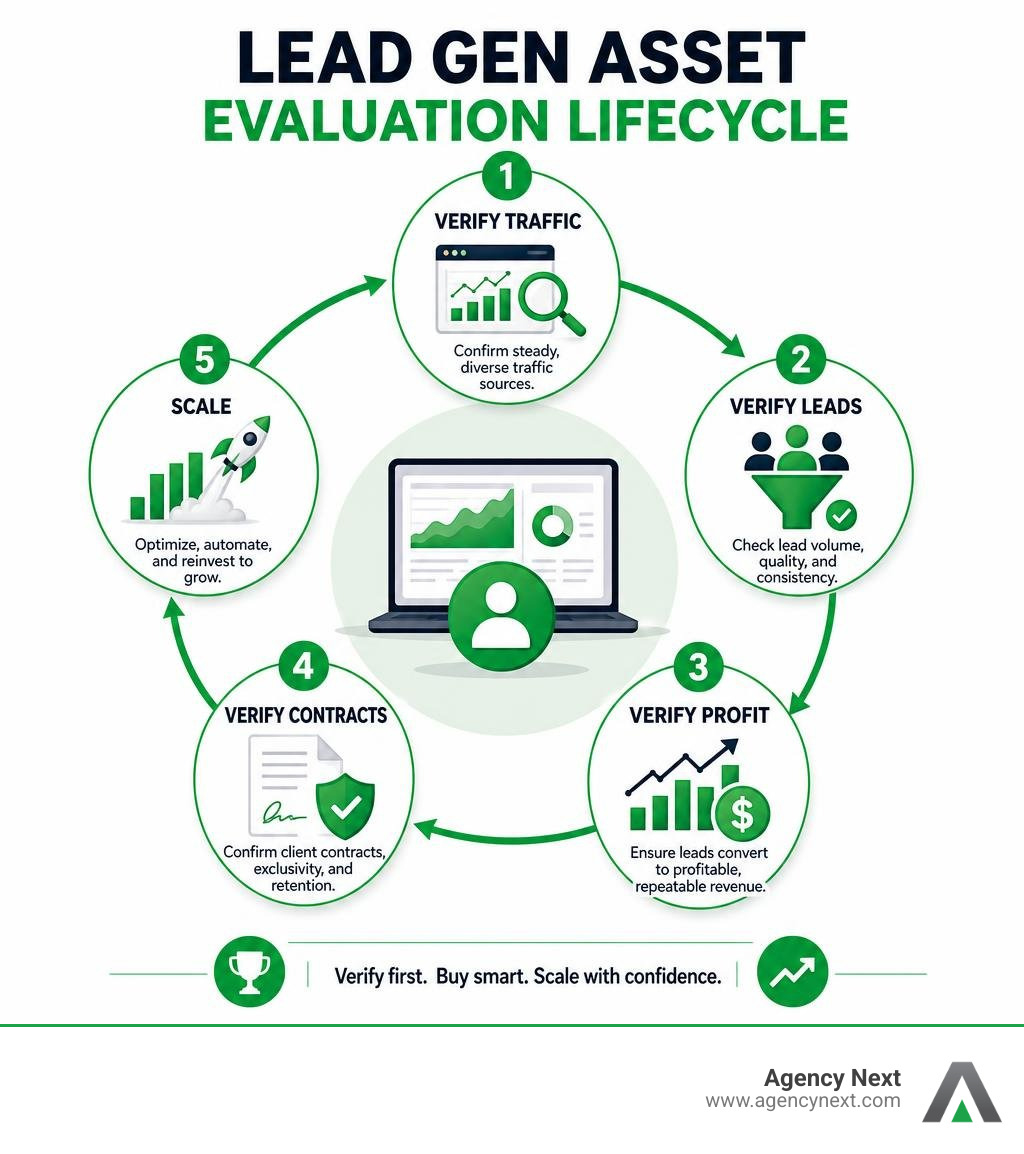
Buying a pre-built lead generation website can give a local service business a faster path to online leads than building from zero. But do not judge the deal by traffic or a polished website alone. Verify where leads come from, what each lead earns, whether buyers keep paying, and how much work the asset needs to run.
Use this quick first-pass checklist for lead generation websites for sale:
- Confirm at least 6 to 12 months of revenue, profit, and lead-volume records.
- Review traffic sources. A site dependent on one Google ranking, ad account, or referral partner carries more risk.
- Check lead quality, conversion rates, exclusivity, and client contracts.
- Value the business from trailing net profit, then adjust for stability, growth potential, and owner workload.
- Audit SEO health, compliance, CRM access, domains, content, and all assets included in the transfer.
Lead gen businesses make money by connecting prospective customers with companies that need work. That can mean pay-per-lead fees, recurring agency retainers, affiliate commissions, revenue share, or software subscriptions. The best acquisition is not simply the one with the highest stated profit. It is the one whose lead engine you can understand, verify, and improve.
For a plumber, landscaper, or other local operator, an acquired digital asset may offer a useful head start: existing search visibility, conversion pages, call tracking, and buyer relationships. Yet those same assets can lose value quickly if lead flow relies on weak backlinks, shared leads, unprofitable ad spend, or a client who can leave next month.
This guide will help you separate a real lead-producing asset from an expensive website with a good sales pitch.
Koby Luedtke & the AGENCY NEXT Team will walk you through the practical checks that matter before and after an acquisition.
Understanding Business Models Behind Lead Generation Websites for Sale
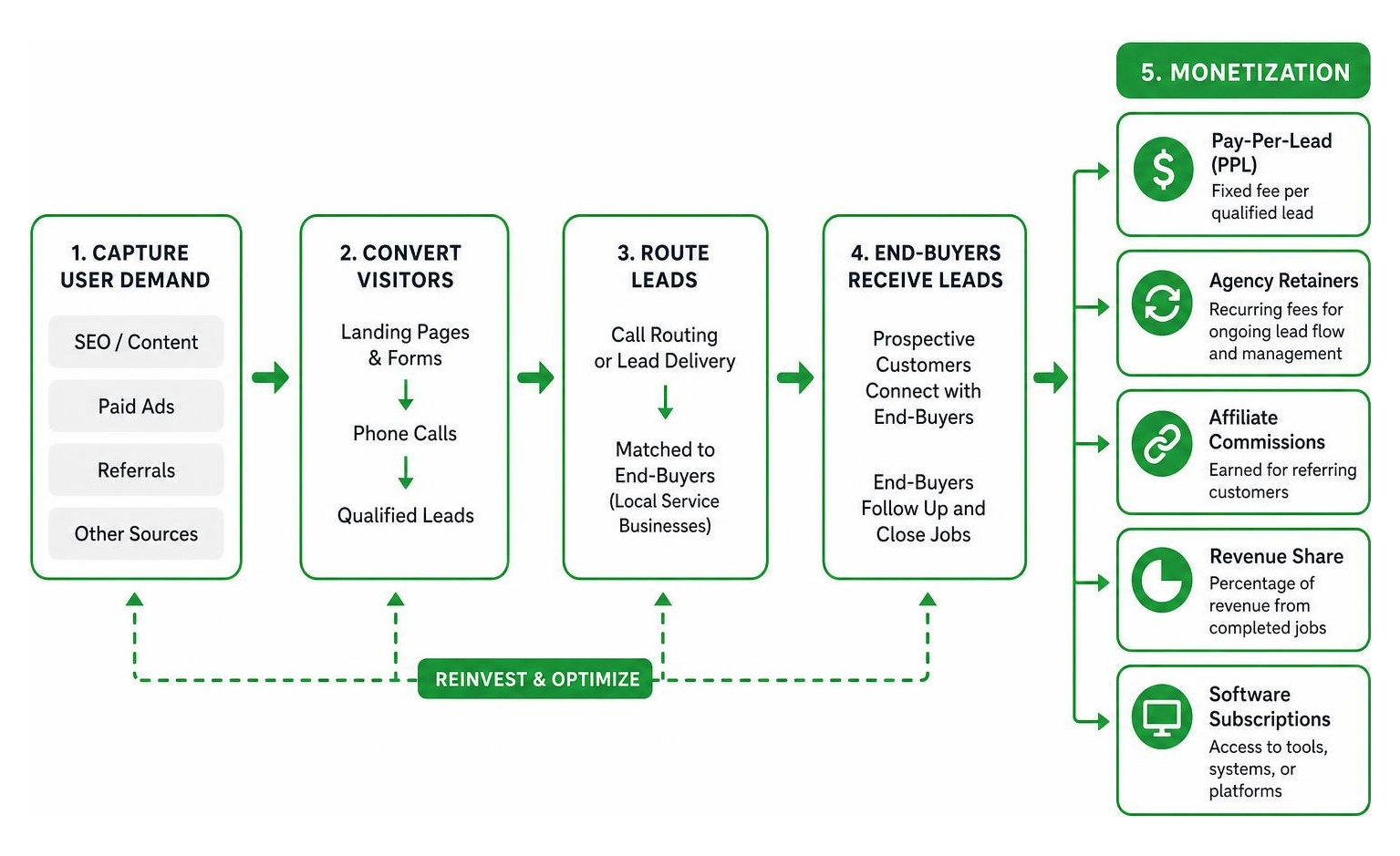
Digital lead generation models share one fundamental mechanism: capturing user demand and routing that commercial intent to paying end-buyers. How you get paid, how reliable that income is, and the operational demands on your time depend heavily on the underlying business structure.
When navigating listings across digital asset brokerages, you will encounter diverse operational frameworks. Some systems function as automated pipelines where leads flow directly to end-service providers via dynamic call routing. Others require daily management of media spend or software infrastructure.
Core Monetization Models and Revenue Streams
The monetization architecture dictates both your cash flow stability and operating margins:
- Pay-Per-Lead (PPL): Buyers pay a fixed rate per qualified inquiry, inbound phone call, or completed form submission. Margins routinely fall between 30% and 70%, though lead disputes, return policies, and seasonal demand require active tracking.
- Flat-Fee Recurring Retainers: Service providers pay a predictable monthly rate for exclusive access to all inbound inquiries from specific zip codes or service categories. This model minimizes transactional disputes and stabilizes cash flow.
- Cost-Per-Acquisition (CPA) & Affiliate Commissions: The asset captures consumer intent and redirects traffic to enterprise networks or national brands, earning commissions upon qualified actions or finalized sales.
- Software & B2B Subscriptions: Advanced assets utilize automated discovery tools or programmatic platforms. Acquiring Turnkey Lead Generation SaaS solutions allows operators to charge recurring software access fees alongside direct usage credits.
Evaluating Types of Lead Generation Websites for Sale
Digital lead assets generally fall into five distinct categories:
- Rank-and-Rent Local Sites: Geo-targeted web properties built to secure top search visibility for high-intent queries (e.g., emergency plumbing, roofing, or tree care) and leased to local contractors.
- Specialized SaaS Platforms: Tools such as LeadFinder platforms that automate prospect identification, scrapers, or validation workflows on subscription infrastructure.
- National Lead Marketplaces: Multi-vertical hubs like an established marketplace for local service pros connecting regional consumers with vetted trade contractors across hundreds of metropolitan zones.
- Affiliate & Content Engines: Content-heavy sites driving high-volume consumer traffic into high-ticket affiliate verticals such as legal settlements, financial instruments, or medical tourism.
- Agency Hybrid Portfolios: Portfolios delivering end-to-end inbound marketing, paid search management, and dynamic lead capture under long-term client contracts.
Valuation Frameworks and Financial Benchmarks for Digital Lead Assets
Valuing lead generation assets requires evaluating historical stability, net margins, traffic sustainability, and operational complexity. High-ticket verticals with contractual buyer agreements command substantial valuation premiums, whereas sites reliant on volatile organic rankings trade at lower multiples.
| Industry Vertical | Monthly Revenue Range | Monthly Net Profit | Typical Multiple Range | Key Valuation Drivers |
|---|---|---|---|---|
| Legal & Mass Tort | $100,000 – $500,000+ | $30,000 – $120,000+ | 45x – 60x | High case settlement values, signed firm contracts, rigorous compliance |
| Financial Services | $40,000 – $100,000 | $15,000 – $40,000 | 30x – 38x | Direct CPA commission agreements, diversified lead buyers |
| Home & Trade Services | $3,000 – $15,000 | $2,000 – $10,000 | 28x – 34x | Local map pack visibility, direct contractor retainers, low churn |
| Medical Tourism / Healthcare | $30,000 – $70,000 | $20,000 – $45,000 | 20x – 26x | Retainer-based agreements, direct clinic placement fees |
| B2B SaaS / Micro-SaaS | $1,000 – $20,000 | $500 – $15,000 | 25x – 40x | Proprietary software IP, monthly recurring revenue (MRR), automated workflows |
Calculating Multiples and Profit Margins
Digital asset marketplaces value businesses using a standard formula:
$$\text{Valuation} = \text{Monthly Multiple} \times \text{L12M Average Monthly Net Profit}$$
$$\text{Net Profit} = \text{Gross Revenue} – (\text{COGS} + \text{Hosting/Tools} + \text{Direct Ad Spend} + \text{Outsourced Labor})$$
When reviewing AI-driven lead platforms, verify recurring SaaS metrics, software hosting overhead, and API compute costs alongside baseline revenue.
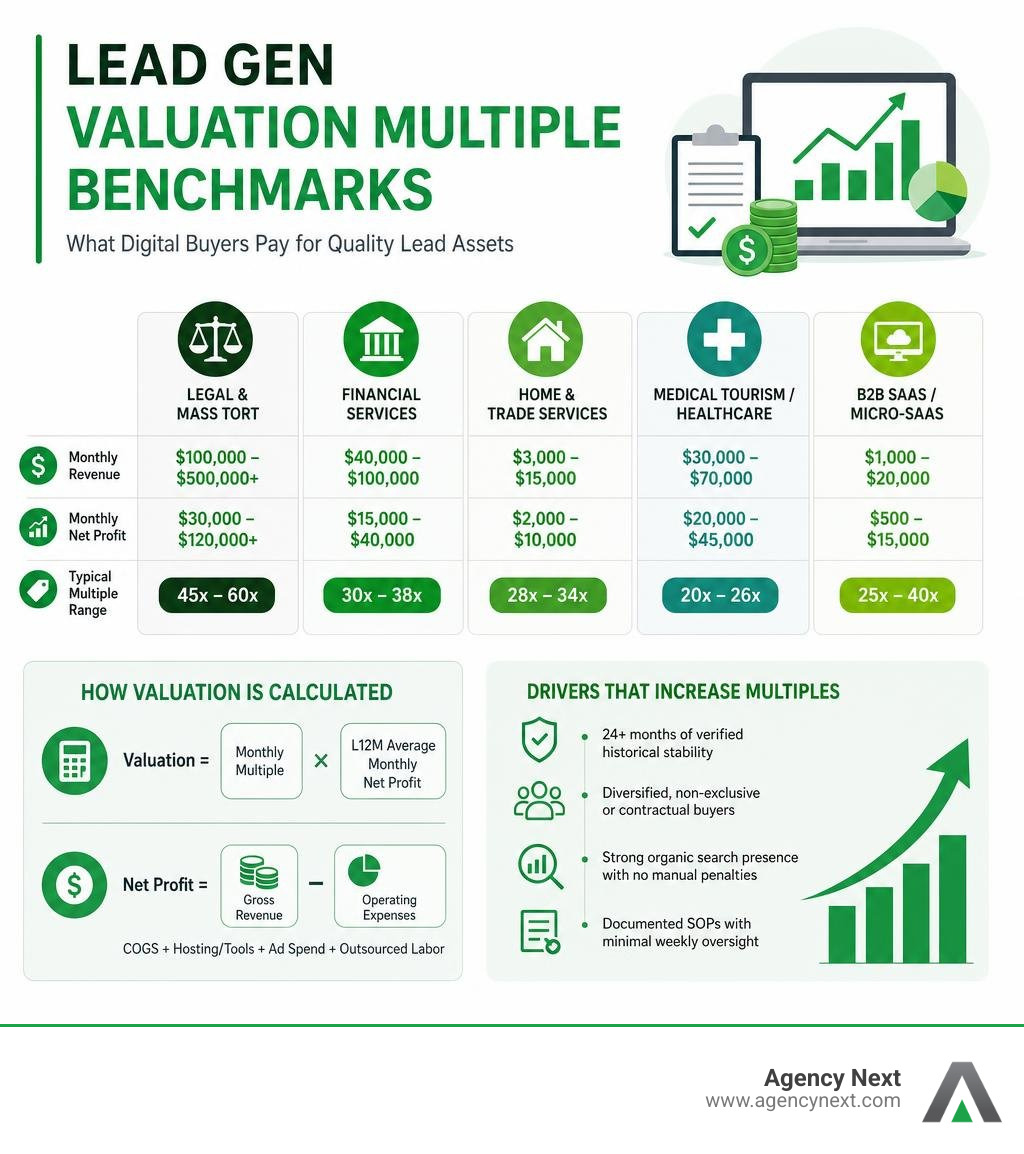
Multiples shift upward when an asset demonstrates:
- Verified historical stability spanning 24+ months without sharp seasonal drop-offs.
- A diversified base of non-exclusive or contractual buyers.
- Organic, authoritative search presence with zero manual penalties.
- Documented Standard Operating Procedures (SOPs) requiring minimal weekly oversight.
Passive Income Assets vs. Strategic Flipping
Before reviewing listings, establish your operational objective:
- Cash Flow & Passive Income: Target established sites in stable local service niches with verified organic rankings, low maintenance overhead, and long-term retainer agreements. Your goal is operational continuity, steady dividend yields, and capital preservation.
- Strategic Turnaround & Flipping: Target undervalued web properties with strong legacy domain authority but poor monetization, unoptimized landing pages, or high lead abandonment. Applying conversion optimization and adding new buyer partnerships allows you to expand net margins rapidly and exit at a higher multiple within 12 to 24 months.
Essential Due Diligence and Risk Assessment Framework
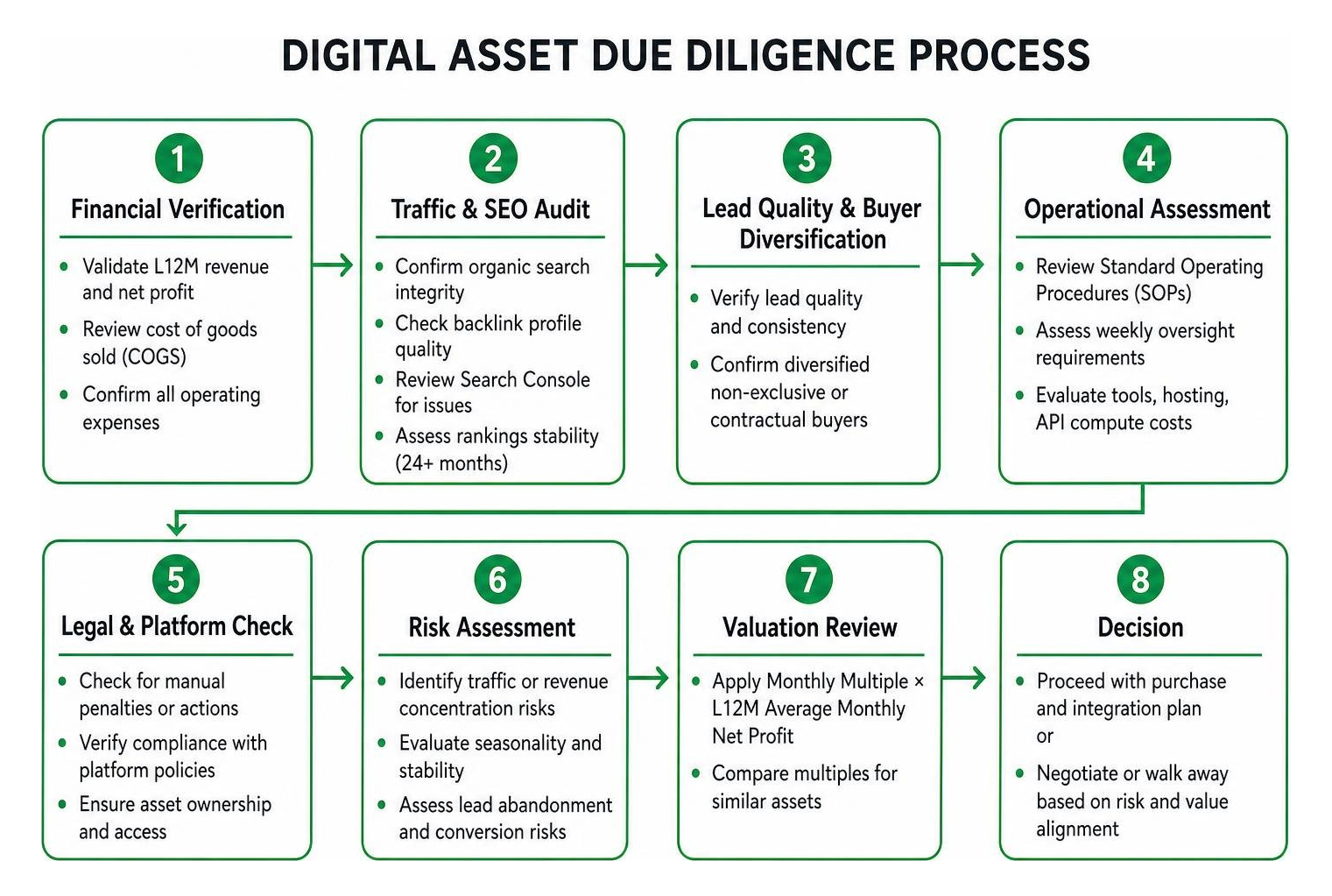
Proper due diligence separates defensible digital assets from inflated listings vulnerable to sudden traffic or revenue collapse.
Technical Audit: Traffic Diversity, SEO Health, and Rankings
A technical audit confirms that inbound lead flow comes from legitimate, sustainable channels rather than artificial surges or risky backlink networks:
- Organic Search Integrity: Audit the backlink profile for private blog networks (PBNs), automated link schemes, or toxic anchors. Check Google Search Console for manual actions, indexing drops, or keyword cannibalization. Partnering with an experienced digital marketing SEO agency provides clear technical clarity during this discovery window.
- Traffic Distribution: Review Google Analytics for channel diversification. An asset that draws 40% of its traffic from organic search, 35% from paid acquisition, and 25% from direct or referral channels is far more resilient than one relying on a single volatile search term.
- Paid Media Efficiency: If the asset relies on paid ads, analyze historic Cost Per Acquisition (CPA), Return on Ad Spend (ROAS), and ad account standing to ensure customer acquisition costs remain profitable.
Commercial and Legal Verification for Lead Generation Websites for Sale
Financial and regulatory verification protects your investment against sudden liabilities:
- Proof of Funds & Earnings: Verify bank statements, merchant accounts (Stripe/PayPal), and payout receipts against internal Profit and Loss (P&L) statements. Never rely solely on self-reported seller figures.
- Buyer Contract Durability: Review client agreements to confirm exclusivity terms, payment timeframes, dispute windows, and termination clauses. Ensure that contracts legally transfer to new ownership upon acquisition.
- Regulatory Compliance: Confirm strict alignment with consumer privacy and communications laws:
- TCPA (Telephone Consumer Protection Act): Ensure lead capture forms include unambiguous consent disclosures for automated dialing and text messaging.
- CAN-SPAM & Data Privacy: Confirm that email capture funnels and outbound sequences comply with state and federal data privacy standards.
- Escrow Safeguards: Execute transactions through reputable escrow services to inspect codebases, verify domain ownership, and test lead-routing webhooks before releasing funds.
Post-Acquisition Growth and Scaling Strategies
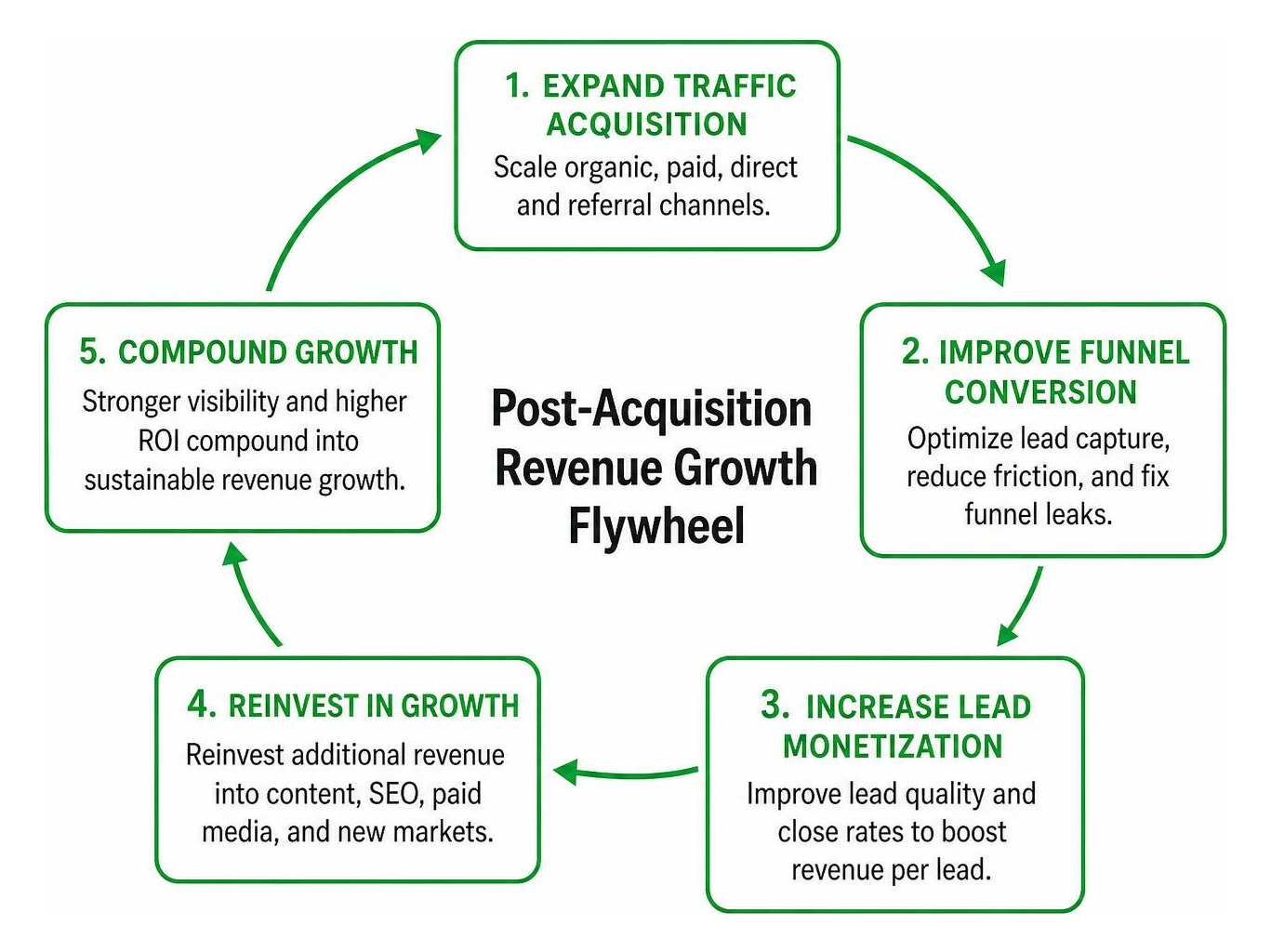
Closing the transaction is only the starting line. True equity growth comes from expanding traffic acquisition channels, plugging funnel leaks, and improving lead monetization.
Scaling Organic Reach and Search Visibility
Organic search remains a reliable, high-margin channel for local and regional lead generation:
- Content & Keyword Expansion: Identify untapped, long-tail commercial queries in secondary geographic markets. Deploy structured keyword research using a professional keyword ranking service to secure rankings for bottom-of-funnel service searches.
- Technical Optimization & Local Footprint: Implement comprehensive local business schema markup, optimize core page performance, and acquire geo-relevant citations. Leveraging structured SEO packages helps streamline backlink outreach, local citation building, and ongoing content velocity.
- Domain Authority Strengthening: Expand the site’s authority by producing original research, industry data benchmarks, and digital PR campaigns that attract editorial backlinks naturally.
Conversion Rate Optimization and Lead Automation
Increasing conversion efficiency directly scales monthly profit without requiring additional traffic spend:
- Speed-to-Lead Workflows: Research shows that responding to an online inquiry within 5 minutes increases conversion odds significantly. Connect lead capture forms to automated SMS notifications and AI-assisted qualification bots.
- Form & Landing Page Optimization: Run A/B split tests on form lengths, call-to-action (CTA) buttons, trust badges, and click-to-call mobile triggers.
- Unsold Lead Monetization: Many platforms leave high percentages of secondary leads unsold. Introduce multi-tier bidding rules or secondary distribution networks to monetize excess inquiries. For comprehensive technical execution across web design, conversion optimization, and automated funnels, review our full suite of digital services.
Frequently Asked Questions About Lead Generation Websites for Sale
How are lead generation websites valued for acquisition?
Valuations are determined by applying a monthly multiple (typically ranging from 20x to 60x, or 2x to 5x annual net profit) to the business’s average trailing 12-month (L12M) net profit. High-ticket niches with recurring retainer agreements command the highest multiples, while sites with single-buyer dependencies or unverified traffic trade at lower ranges.
What are the biggest red flags when buying a lead generation website?
Major warning signs include:
- Over 60% of total revenue tied to a single client or referral partner.
- Sudden traffic spikes from automated or low-quality backlink networks right before listing.
- High lead rejection, return, or chargeback rates from existing buyers.
- Lack of clear TCPA-compliant consent language on lead collection forms.
- Discrepancies between seller P&L sheets and actual merchant account payouts.
How quickly can a buyer achieve positive ROI on an acquired lead gen asset?
Well-vetted lead generation businesses generate cash flow immediately upon closing. Typical payback periods range from 24 to 36 months under static performance. However, buyers who implement conversion rate optimization, monetize unsold lead volume, and broaden organic search visibility can shorten payback windows to 14 to 18 months.
Conclusion
Acquiring a pre-built lead generation asset gives you immediate access to established traffic channels, inbound customer volume, and cash flow. Yet sustainable profitability requires looking beyond top-line revenue to rigorously assess organic traffic health, buyer retention, lead exclusivity, and technical infrastructure.
By conducting thorough due diligence, valuing assets against verified trailing net earnings, and executing targeted post-acquisition optimization strategies, you can build a resilient digital asset portfolio. Whether you aim to generate steady passive cash flow or scale an asset for a profitable exit, strategic execution makes all the difference.
Ready to build, scale, or transform high-converting lead generation engines for your enterprise? Partner with our growth team at Agency Next to implement conversion-focused website designs, organic search campaigns, and digital strategies built for compounding ROI.