
Hiring a Google Ranking Expert to Secure Top Search Positions

Why Hiring a Google Ranking Expert Matters in 2026
A Google ranking expert helps your business earn more visibility in Google Search, Google Maps, and AI-powered results by fixing technical issues, matching pages to what customers search for, and building trustworthy authority over time.
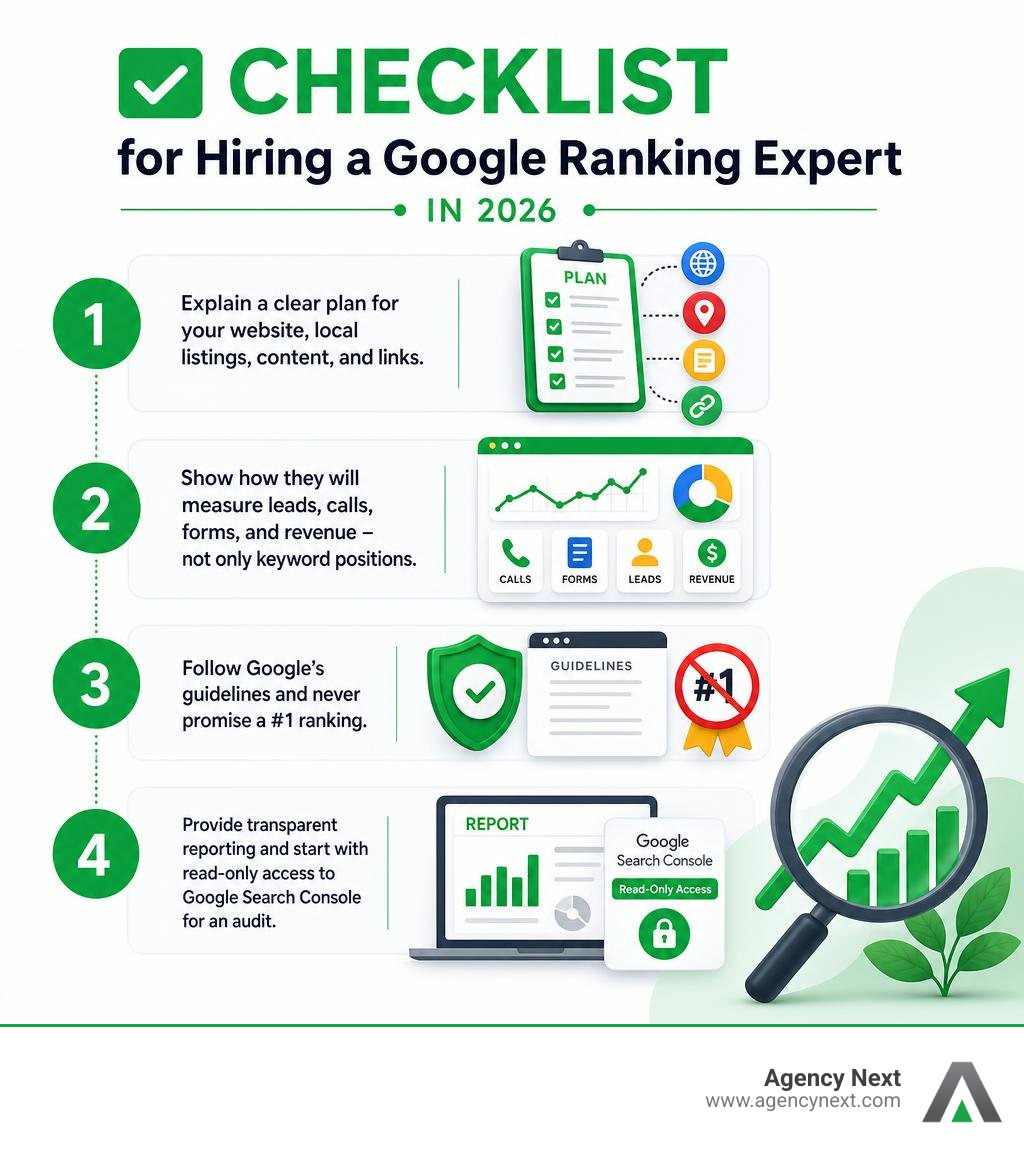
Before hiring one, look for a professional who can:
- Explain a clear plan for your website, local listings, content, and links.
- Show how they will measure leads, calls, forms, and revenue – not only keyword positions.
- Follow Google’s guidelines and never promise a #1 ranking.
- Provide transparent reporting and start with read-only access to Google Search Console for an audit.
For a local service business, this work can mean showing up when nearby customers search for services like “emergency plumber near me” or “landscaper in [city].” It also means making your site fast, mobile-friendly, easy for Google to crawl, and convincing enough to turn visits into calls.
Search has changed fast. More than half of searches can end without a click because users get answers directly in search features and AI systems. That makes classic SEO still essential, but no longer enough on its own. The right expert helps you compete for organic listings, map results, and citations in AI answers without resorting to risky shortcuts.
This guide from Koby Luedtke & AGENCY NEXT Team will help you compare and hire a ranking professional with confidence.
What Does a Google Ranking Expert Do in 2026?
The role of an optimization specialist has evolved far beyond stuffing metadata with keywords and hoping for the best. In 2026, Google processes queries through sophisticated neural networks, intent-matching systems, and automated quality raters designed to evaluate hundreds of billions of indexed web pages in milliseconds.
At its core, search optimization revolves around three pillars:
- Crawling efficiency: Ensuring Googlebot can locate, request, and parse your site’s resources without server timeouts or blocked paths.
- Indexation health: Confirming that the right canonical pages are stored inside Google’s index while duplicate or thin parameter pages are filtered out.
- E-E-A-T principles: Aligning your site’s content with Google’s Experience, Expertise, Authoritativeness, and Trustworthiness guidelines.
Top industry minds, such as Aleyda Solis, Strategical SEO & AI Search Optimization Consultant, emphasize that modern search consulting requires bridging traditional technical roadmaps with content gap models to produce scalable organic growth. A qualified specialist does not just bring traffic; they align search demand with your business model.
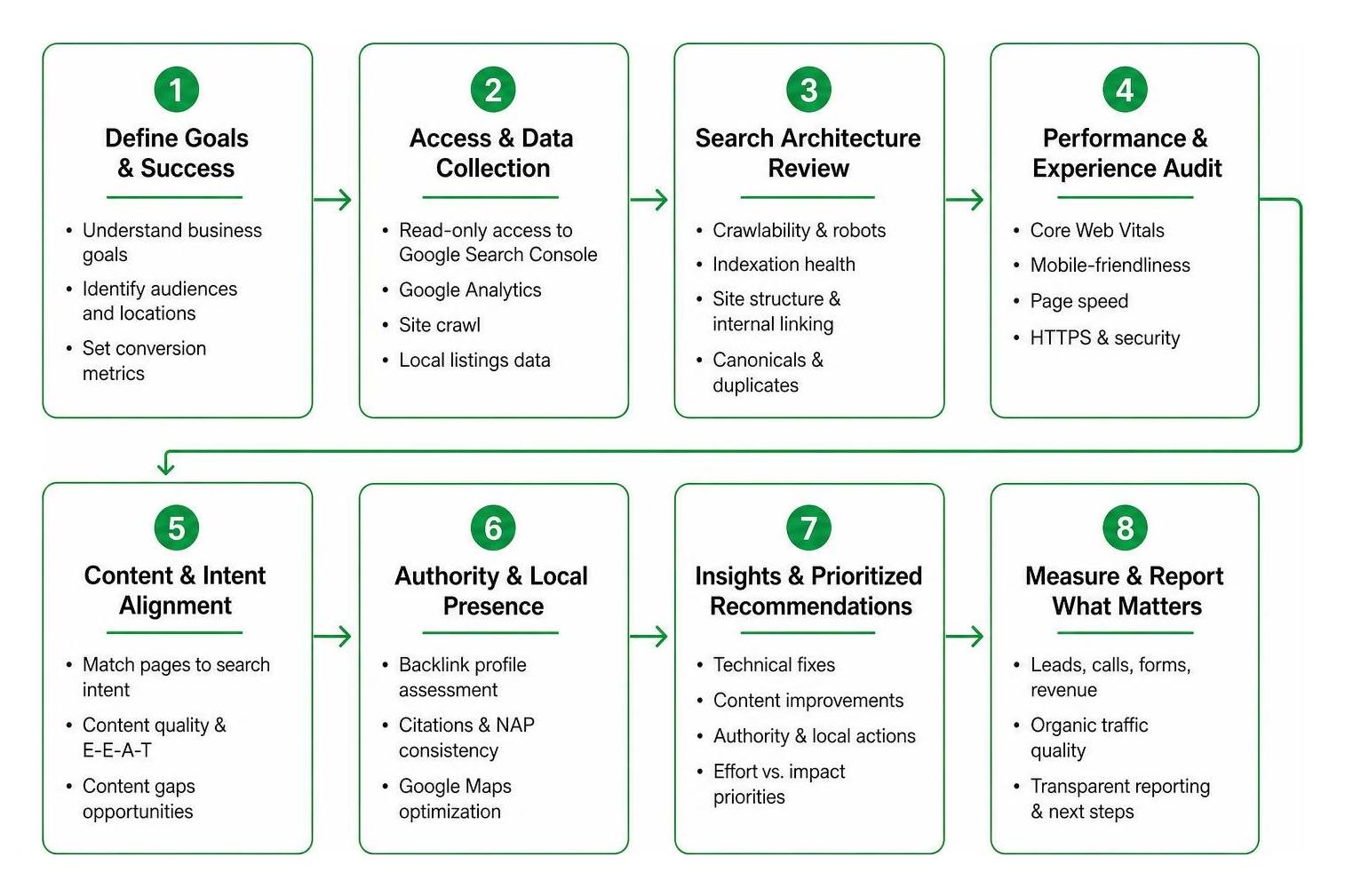
Technical SEO, Crawlability, and Core Web Vitals
Technical SEO forms the foundation upon which all content and link signals rest. If search bots cannot render your code efficiently, your organic visibility stalls before ranking algorithms even begin their assessment.
A seasoned consultant focuses on:
- Robots Exclusion Protocol: Conforming to modern standards like RFC 9309 to ensure robots.txt files guide search engine crawlers without creating soft 404 traps. Google analysts like Gary Illyes – 200 OK frequently point out the importance of clean server responses and polite crawling behavior.
- XML Sitemaps and Rendering: Delivering clean sitemap feeds that prioritize key URLs and resolve rendering bottlenecks caused by heavy client-side JavaScript.
- Core Web Vitals: Optimizing page loading speed, layout stability (CLS), and interaction responsiveness (INP) to satisfy Google’s page experience requirements across desktop and mobile devices.
- Structured Data: Implementing schema markup to define organizations, local services, products, FAQs, and breadcrumbs, making it seamless for search engines to understand your entities.
Generative Engine Optimization and AI Answer Engines
With over 50% of searches now resulting in zero clicks, users frequently get their answers directly within Google AI Overviews or conversational engines. Consequently, optimization has expanded into Generative Engine Optimization (GEO) and Answer Engine Optimization (AEO).
Former Google search engineers like fili: SEO & GEO expert, ex-Google engineer & speaker highlight that strong technical fundamentals allow both traditional bots and large language models (LLMs) to crawl, parse, and cite content easily. Modern optimization requires:
- Structuring copy with clear definitions, direct answers, and bulleted takeaways that answer engines can lift as direct citations.
- Earning third-party brand citations across trusted industry publications to corroborate on-page claims.
- Targeting multi-turn conversational queries rather than relying solely on single-keyword search volume.
Essential Strategies Executed by Ranking Professionals
A skilled practitioner applies a balance of on-page refinement, authority acquisition, and localized optimization to deliver durable results.
On-Page Optimization and Content Quality Systems
On-page optimization matches user search intent with structured, authoritative content. Keyword stuffing is obsolete; Google’s language models now evaluate contextual relevance and synonyms seamlessly.
To stay competitive, we conduct rigorous Competitor Keyword Analysis to discover keyword gaps, map primary and secondary terms across page clusters, and refresh existing pages to maintain content freshness signals.
Key on-page practices include:
- Writing descriptive title tags and meta descriptions that entice clicks without misleading users.
- Structuring content with intuitive H2 and H3 subheadings that answer immediate search queries.
- Building contextual internal links that distribute page authority and help crawlers navigate related topics.
Authority Building, Off-Page Signals, and Backlink Acquisition
Backlinks remain one of Google’s primary quality signals. In Google’s ranking systems, links from reputable websites act as third-party votes of confidence.
Search practitioners evaluate backlink profiles to protect sites against toxic links and algorithmic suppression. Acquiring high-authority Dofollow SEO Backlinks through targeted outreach, digital PR, and industry thought leadership strengthens your domain’s credibility over time.
Strategic practitioners like Paul Andre de Vera have demonstrated that combining technical health with targeted authority building and conversion rate optimization (CRO) can dramatically lift organic impressions and drive enterprise-scale revenue.
Local SEO Dominance and Google Business Profile Optimization
For local service providers, Google Business Profile (GBP) management and local map pack optimization are critical.
Dominating the local map pack involves:
- NAP Consistency: Ensuring your business Name, Address, and Phone number are identical across top directories and citations.
- Review Generation & Management: Actively collecting positive customer reviews and responding to feedback promptly.
- Profile Activity: Regularly publishing GBP updates, uploading high-resolution photos, and maintaining accurate service categories.
- Geo-Targeted Content: Developing localized landing pages that reflect the exact areas and communities you serve.
How to Hire the Right SEO Professional for Sustainable Growth
Choosing the right consultant or agency can transform your digital revenue, while hiring an inexperienced provider risks algorithmic penalties.
| Strategy Dimension | White-Hat SEO (Sustainable) | Black-Hat SEO (High Risk) |
|---|---|---|
| Link Building | Digital PR, guest outreach, editorial links | Automated link farms, private blog networks (PBNs) |
| Content Creation | Expert-led, intent-focused, original assets | Scraped text, spun AI text, keyword stuffing |
| Technical Health | Clean architecture, schema, fast rendering | Hidden text, cloaking, doorway redirects |
| Timeline & Guarantees | Gradual, compounding gains (3–12 months) | “Guaranteed #1 rank in 30 days” promises |
| Risk Profile | Algorithm-resilient, builds long-term asset value | Manual actions, de-indexing, brand reputation loss |
Core Proficiencies Every Google Ranking Expert Must Possess
When evaluating prospective partners, verify that they possess a well-rounded skill set:
- Data Analytics Mastery: Expertise in Google Search Console, Google Analytics 4, and server log analysis to measure traffic quality and attribution.
- Technical Problem-Solving: The ability to identify crawl traps, canonical conflicts, and mobile usability bugs.
- CRO Integration: Aligning search visibility with conversion design, turning incoming organic traffic into leads, booked calls, and sales.
- Strategic Roadmapping: Setting realistic milestones and communicating technical needs clearly to developers, copywriters, and executives.
Vetting a Google Ranking Expert: Questions and Red Flags
Protect your domain by asking targeted interview questions:
- What specific signals will you evaluate during an initial website audit?
- How do you approach link acquisition, and what methods do you avoid?
- How do you measure campaign performance beyond keyword rankings?
- Can you provide references or case studies demonstrating organic growth?
Red Flags to Watch Out For:
- Guaranteed #1 Rankings: Google explicitly warns that no agency has a special relationship or priority submission channel with search engines.
- Secret Strategies: Transparent practitioners clearly explain their methodologies without hiding behind proprietary “black-box” magic.
- Instant Result Claims: Be cautious of suspicious Cheap SEO Packages that promise instant results using low-quality link schemes.
- Demanding Full Administrative Access Immediately: Initial technical audits require only read-only access to your Google Search Console and analytics properties.
Frequently Asked Questions About Hiring SEO Experts
How long does it take for an SEO specialist to achieve top Google rankings?
Organic search is a compounding marketing channel. In most industries, tangible ranking improvements and traffic growth require between 3 to 6 months of continuous optimization, while competitive enterprise keywords can take 9 to 12 months. Timelines depend heavily on domain age, current backlink profile strength, competition level, and the speed at which your technical team implements recommendations.
Can an optimization specialist guarantee a number one ranking on Google?
No. Google’s algorithms operate autonomously using hundreds of real-time signals, frequent core updates, and localized context. Reputable consultants focus on proven best practices, technical compliance, and sustainable traffic growth rather than impossible ranking guarantees.
What tools do top SEO consultants use to analyze ranking performance?
Professional ranking experts use an array of industry-standard tools:
- Crawl Diagnostics: Screaming Frog SEO Spider, Sitebulb
- Performance & Search Intelligence: Google Search Console, Google Analytics 4, BigQuery
- Competitive Research & Tracking: Semrush, Ahrefs, Moz
- Speed & Usability: Google PageSpeed Insights, Chrome DevTools
To learn more about optimization frameworks, explore our helpful digital Resources to expand your search marketing knowledge.
Conclusion
Securing durable Google rankings requires a cohesive strategy that integrates technical site architecture, intent-matched content creation, authoritative link building, and conversion-focused design. As search systems integrate AI answer engines and zero-click answer boxes, working with an experienced partner ensures your business remains visible, authoritative, and profitable.
At Agency Next, we build conversion-focused digital systems that transform search engine visibility into measurable revenue. Discover how our tailored Services can elevate your organic growth and help your business capture top positions across modern search platforms.