
Scaling Online Stores with Ecommerce SEO Expertise

Why an Ecommerce SEO Consultant Can Help Your Store Grow
An ecommerce SEO consultant helps online stores earn more qualified traffic from Google and other search tools by improving product pages, category pages, site structure, speed, and content. The goal is not simply to rank for more keywords. It is to help the right shoppers find your store, trust it, and buy.
Organic search can drive up to 43% of ecommerce traffic, making it a major customer discovery channel. For a local business adding online sales, SEO can create a more durable source of leads and revenue than paid ads alone, which stop the moment the budget ends.
| What an ecommerce SEO consultant does | Why it matters |
|---|---|
| Finds buyer-focused keywords | Helps your products appear for searches with purchase intent |
| Fixes technical SEO problems | Makes it easier for search engines to crawl and index your store |
| Improves product and category pages | Gives shoppers and search engines clearer reasons to choose your offer |
| Builds useful content and internal links | Captures research-stage searches before competitors do |
| Tracks organic traffic, sales, and conversions | Connects SEO work to business results, not vanity metrics |
Ecommerce SEO is different from standard website SEO. Stores often manage hundreds of products, duplicate pages, filters, product variants, out-of-stock items, and slow images. They also need to compete in shopping results and AI-driven search experiences, where clear product data and trustworthy content matter more than ever.
I am Koby Luedtke, Co-Founder of Agency Next, where I help businesses become more visible, trusted, and profitable through conversion-focused websites, SEO, AI-powered video, and digital strategy. This guide explains what to expect from an ecommerce SEO consultant and how to assess whether SEO can become a real growth channel for your online store.
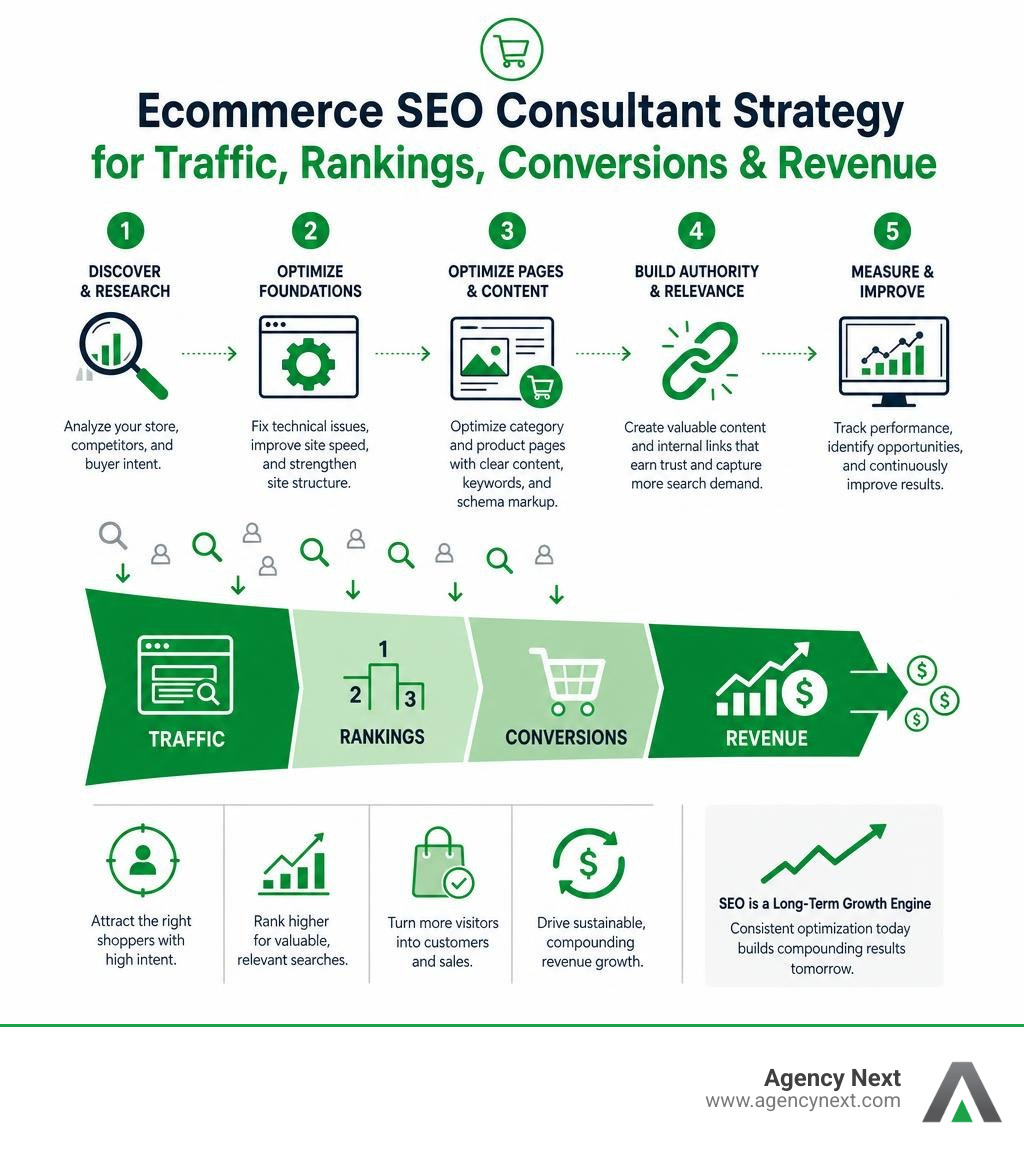
What Does an Ecommerce SEO Consultant Do?
An ecommerce SEO consultant serves as a strategic and technical partner who helps online store owners turn search engines into predictable revenue streams. Rather than offering generic marketing advice, an experienced consultant digs deep into the unique architecture, technical infrastructure, and catalog structure of your store.
At its core, the consultant’s job is to increase non-branded organic search traffic—shoppers searching for products you sell without knowing your brand name yet. When we audit or optimize an ecommerce store, our team focuses on aligning what search engines want to crawl with what buyers actually want to buy. This requires a balanced approach combining technical site audits, commercial keyword mapping, user experience improvements, and strategic content planning. For additional web optimization advice, review our Tips for Creating an SMB Website That Actually Converts.
Essential Responsibilities of an Ecommerce SEO Consultant
Working with an ecommerce SEO consultant covers every layer of search optimization. Here are the core responsibilities you can expect a dedicated professional to manage:
- Ecommerce Keyword Research: Uncovering high-intent, commercial keywords that reflect actual buyer intent rather than broad educational queries.
- Category & Collection Page Architecture: Structuring catalog hierarchies so search engines understand product relationships and high-value landing pages gain max authority.
- Technical SEO Fixes: Eliminating crawl bloat, canonical errors, pagination issues, and broken internal links across thousands of SKUs.
- Structured Data & Schema Markup: Implementing rich snippet tags (Product, Review, Price, Availability schema) to capture eye-catching SERP features and AI Overviews.
- Off-Page SEO & Backlink Strategies: Building domain authority through high-quality links, digital PR, and strategic partnerships.
Ecommerce SEO vs. Traditional SEO
Many store owners ask us how ecommerce search optimization differs from traditional service-based SEO. While classic SEO focuses primarily on local citations or service pages, ecommerce search strategy revolves around high transactional intent and technical scale.
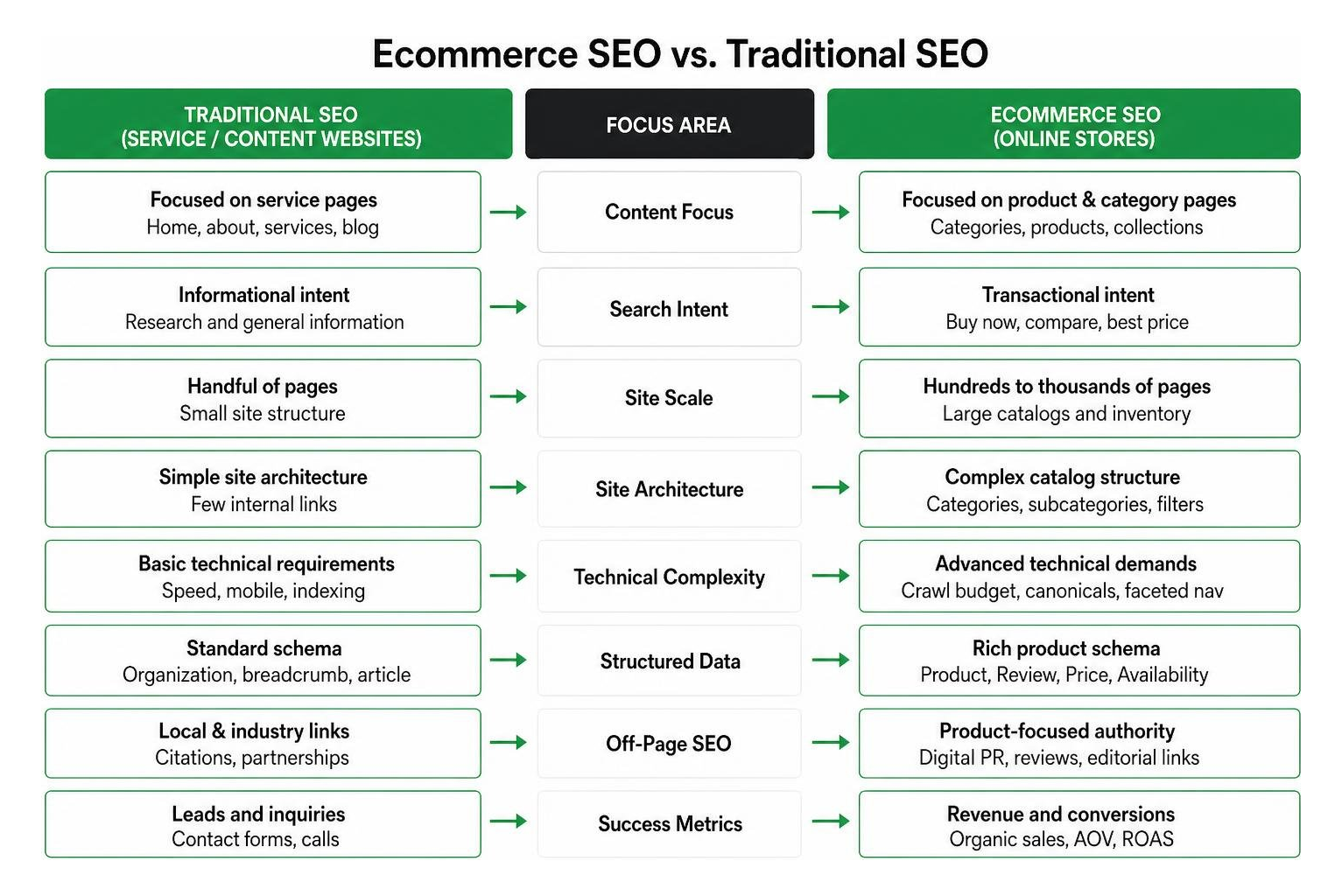
In ecommerce, search queries carry explicit buying intent (e.g., “buy men’s waterproof hiking boots”). Additionally, online stores deal with technical challenges rarely found on standard websites:
- Faceted Navigation: Color, size, and price filters often create thousands of duplicate or dynamic URLs that waste search engine crawl budgets if not properly configured.
- SKU & Inventory Management: Managing out-of-stock items, seasonal variations, and discontinued SKUs without creating broken 404 pages or losing ranking history.
- Product Variants: Determining whether individual product colors/sizes deserve unique URLs or should be canonicalized back to a parent product page.
- Crawl Bloat: Preventing search engine bots from wasting time indexing tag archives, search result pages, or administrative directories instead of high-value category pages.
Core Strategies for Optimizing Digital Storefronts

Scaling an online storefront requires a holistic optimization framework. You cannot rely solely on basic keyword density; your store must load fast, convey immediate brand authority, and present structured information seamlessly to both human buyers and search engine crawlers.
Technical SEO, Site Speed, and AI Search Optimization
Technical stability forms the bedrock of any successful ecommerce strategy. When web pages take longer than a couple of seconds to process, drop-off rates spike dramatically. Research demonstrates that web pages that load within 1 to 2 seconds achieve the highest ecommerce conversion rates.
To maximize page speed and technical health, an ecommerce SEO consultant will:
- Compress heavy product photography using modern image formats like WebP.
- Minimize app script bloat, third-party JavaScript tracking, and unneeded CSS file assets.
- Fix canonical tag loops and consolidate dynamic parameters created by URL filters.
Furthermore, search engines have transformed radically as we move through 2026. Today’s search tools rely heavily on AI-driven summaries and Large Language Models (LLMs). Optimizing for these generative search formats requires comprehensive structured data markup. By using exact Product Schema, BreadcrumbList markup, and review aggregation, we ensure search engine bots and AI systems can parse your prices, stock status, and features accurately. Learn more about how we blend automation and search strategy through AI Human Collaboration and consult industry frameworks like E-Commerce SEO Consultant strategies for added insights.
Product Page and Content Marketing Best Practices
Every single product detail page (PDP) and category collection page on your site represents a conversion engine. Relying on manufacturer-provided product descriptions is one of the quickest ways to trigger duplicate content issues and drop in rankings.
To transform standard product listings into organic landing pages:
- Write original, benefit-driven product copy tailored to long-tail buyer queries.
- Incorporate clear internal links linking related products, top-level categories, and educational buying guides.
- Implement structured FAQ sections targeting common pre-purchase questions right on the product page.
Content marketing plays a critical role in educating potential customers at the top of the funnel. Producing comprehensive buying guides, comparison charts, and maintenance articles captures shoppers who are still researching their options. For guidance on defining your brand identity across content channels, see How a Strong Brand Story Can Differentiate You From Competitors.
How to Hire the Right Ecommerce SEO Specialist
Choosing between an independent ecommerce SEO consultant and a traditional digital marketing agency depends on your budget, store complexity, and internal team bandwidth. While agencies offer broad teams, specialized individual consultants often provide direct access to high-level technical expertise without passing execution down to entry-level staff.
| Consideration Factor | Independent Ecommerce SEO Consultant | Traditional Marketing Agency |
|---|---|---|
| Primary Contact | Direct access to senior SEO specialist | Account manager or client partner |
| Strategy Tailoring | Fully customized, platform-specific playbooks | Standardized templates & broad workflows |
| Pricings & Retainers | Retainers typically $2,500 – $5,000+/mo | Retainers often $5,000 – $15,000+/mo |
| Implementation | Hands-on execution or direct developer guidance | Multidisciplinary teams across departments |
| Platform Expertise | Specialized store platforms (e.g., custom, Shopify) | General digital channels and broad web tools |
For specialized insights into platform capabilities, resources like specialized platform optimization provide detailed technical context. You can also explore our agency’s past client success via Our Work and Project Archive.
Key Qualities and Red Flags in an Ecommerce SEO Consultant
Finding a reliable partner requires looking beyond surface-level promises. Here are the essential qualities you should demand, along with critical red flags to avoid:
Qualities to Look For:
- Proven track record with stores matching your catalog size or platform.
- Strong analytical approach connecting keyword efforts directly to non-brand revenue growth.
- Deep familiarity with technical search requirements, schema markup, and site migrations.
- Clear, transparent communication and actionable reporting frameworks.
Red Flags to Avoid:
- Guaranteed #1 Rankings: Search algorithms constantly change; no honest professional guarantees ranking spots.
- Black Hat Tactics: Spammy backlinks, private blog networks (PBNs), or hidden text that put your domain at risk of search engine penalties.
- Vanity Metric Focus: Reporting exclusively on raw impressions or arbitrary keyword numbers rather than organic revenue and conversions.
- Lack of Transparency: Refusing to share specific link targets, technical fixes, or optimization tactics being performed.
Pricing Models and Expected Timelines
How much does working with an ecommerce SEO consultant cost? Consulting rates vary depending on store scale, catalog complexity, and scope of work:
- Hourly Rates: Experienced consultants typically range from $100 to $300+ per hour.
- Fixed-Price Technical Audits: Comprehensive site diagnostic audits generally cost between $1,500 and $5,000.
- Monthly Retainers: Dedicated ongoing consulting and execution typically range from $2,500 to $5,000+ per month.
Regarding project timelines, SEO is a compounding long-term investment. Technical fixes often unlock quick ranking movements within 4 to 8 weeks. However, meaningful non-branded revenue growth and organic domain authority usually take 3 to 6 months to mature, with full ROI compounding over 12 months or more. Explore additional strategic guides on our Resources page.
Measuring Results and Navigating Platform Migrations

Measuring success requires tracking the Key Performance Indicators (KPIs) that impact your bottom line. We prioritize measuring total non-brand organic revenue, conversion rates, organic traffic landing page distribution, and backlink health. Marketers consistently recognize this value: 49% of marketers rank organic search as their most profitable channel, with businesses earning up to a 317% ROI on dedicated ecommerce SEO investments.
Website re-platforming or migrations present significant risks to organic revenue if handled incorrectly. Switching store platforms (such as migrating to custom headless storefronts) requires strict technical execution:
- Comprehensive 1:1 301 redirect mapping to prevent broken links.
- Auditing canonical structure and URL syntax across thousands of legacy pages.
- Preserving structured data schemas and category page hierarchies.
- Real-time post-launch crawl error tracking to catch indexing issues immediately.
Consultants like those offering Freelance eCommerce SEO Consultant services emphasize how technical oversight during migrations protects hard-earned organic authority. Discover more about our integrated digital methodologies in our article Unleash Digital Marketing Potential Agency Next Website Types.
Frequently Asked Questions About Ecommerce SEO
How long does it take to see results from ecommerce SEO?
Initial technical improvements, such as removing page errors and improving crawl performance, often generate positive signals within 4 to 8 weeks. However, competitive non-brand keyword growth and significant revenue gains typically take 3 to 6 months of steady work to compound.
How much does an ecommerce SEO consultant cost?
Consultants generally offer project-based audits ($1,500 to $5,000), hourly consulting ($100 to $300/hour), or ongoing monthly retainers ($2,500 to $5,000+/month). The investment depends on your store size and technical needs.
Can an SEO consultant assist with website migrations?
Yes. An ecommerce SEO consultant plays a key role during store migrations by mapping legacy URLs, setting up 301 redirects, auditing metadata transfer, and monitoring search engines post-launch to prevent traffic drops.
Conclusion: Scale Your Store with Expert Search Strategies
Building a dominant online store requires more than great products—it demands an accessible, high-performing digital storefront that search engines love to index and buyers love to navigate. Partnering with a skilled ecommerce SEO consultant ensures your product architecture, technical health, and content strategies align to deliver sustainable sales.
At Agency Next, we build conversion-focused digital ecosystems, drive organic search revenue, and produce AI-powered video assets that transform browsers into loyal buyers. Explore our full suite of solutions on our Services page, or reach out directly to Book a Demo today to see how we can turn your online store into a predictable organic growth machine.