
Driving Pipeline Growth with a B2B SEO Consultant

A b2b seo consultant is an organic growth specialist who aligns a company’s search presence with its underlying sales engine. Standard SEO tactics often chase broad, top-of-funnel traffic volumes, but B2B organic growth operates under entirely different financial dynamics. B2B transactions are rarely impulse buys; they feature high contract values, long decision timelines, and multi-layered purchasing units.
In a modern enterprise or B2B buying journey, purchasing decisions are typically evaluated by a complex buying committee of 6 to 10 decision-makers over a period lasting anywhere from 3 to 9 months. These stakeholders—ranging from CFOs assessing bottom-line ROI to CISOs checking security parameters—conduct extensive self-guided research long before reaching out to a sales representative.
A specialized b2b seo consultant creates search strategies explicitly designed to intercept these distinct personas at every touchpoint. Rather than publishing generic, broad-topic blog posts, they implement “pain-point SEO.” This strategy targets high-intent, bottom-of-funnel queries where prospects actively seek solutions for specific operational bottlenecks. By establishing direct pipeline attribution through CRM integration, consultants tie organic visibility directly to qualified pipeline, pipeline velocity, and closed-won deals.
How B2B SEO Differs from B2C and Generalist SEO Strategies
Understanding the fundamental split between business-to-consumer (B2C) and business-to-business (B2B) search dynamics is critical for driving real ROI. B2C SEO generally focuses on immediate, low-friction conversions, broad consumer interest, and massive search volumes. B2B SEO, on the other hand, navigates high-ticket solutions where lead quality always trumps raw click counts.
| Strategy Feature | B2C / Generalist SEO | Specialized B2B SEO |
|---|---|---|
| Target Audience | Individual consumers making quick choices | Multi-member buying committees with distinct priorities |
| Primary KPI | Organic traffic volume & transaction count | Qualified pipeline created, MQL-to-SQL conversions, ARR |
| Sales Cycle | Instantaneous to short (minutes to days) | Complex & extended (3 to 9 months) |
| Keyword Focus | High-volume, short-tail consumer queries | Low-volume, high-intent problem-aware queries |
| Content Goal | Brand awareness & instant store checkouts | Lead nurturing, trust building, & sales enablement |
When executing B2B search campaigns, targeting low-volume keywords with explicit purchase intent frequently generates far more revenue than chasing broad 50,000-search-per-month terms. For instance, a broad query like “CRM software” brings thousands of unqualified visitors. Conversely, a niche phrase such as “Commercial Construction CRM” might only yield 50 monthly searches, but those searches come directly from ready-to-buy decision-makers. Conversion economics show that capturing a fraction of high-intent searches directly feeds the bottom line.
Key Problems Solved by Hiring a Dedicated B2B SEO Consultant
Many organizations struggle with standard digital marketing agencies due to a common structural flaw: agency value dilution. As traditional agencies scale, founder-level strategic expertise is frequently swapped for junior account managers executing rigid, template-based checklists. This results in vanity metrics—such as impressive-looking traffic growth charts that fail to generate a single extra dollar in actual pipeline.
A dedicated b2b seo consultant resolves this disconnect by acting as a bridge between marketing execution and Revenue Operations (RevOps). They solve foundational execution gaps by:
- Eliminating the Vanity Traffic Trap: Directing content resources toward bottom-of-funnel, high-converting buyer intent rather than empty top-of-funnel pageviews.
- Integrating Advanced CRM Tracking: Connecting analytics platforms like Google Analytics 4 directly into CRMs such as HubSpot or Salesforce to establish clear multi-touch attribution models.
- Aligning Search with Sales Enablement: Designing organic search content that doubles as sales-enablement collaterals for account executives dealing with late-stage objections.
- Bridging Technical Debt: Eliminating rendering, crawlability, and architecture issues across complex corporate web stacks without breaking active conversion pathways.
By partnering with experienced specialists, businesses can seamlessly align their organic search footprint with actual product and sales strategies.
Navigating the New Era of Search: Generative Engine Optimization (GEO)
Search engine optimization is undergoing its most significant structural shift in two decades. The rise of AI-driven answer engines-including Google AI Overviews, ChatGPT, Perplexity, Claude, and Gemini-means buyers no longer rely solely on blue links. Decision-makers increasingly type complex prompts directly into conversational AI interfaces to assemble vendor shortlists.
This evolution has introduced Generative Engine Optimization (GEO) and Answer Engine Optimization (AEO). In modern B2B procurement, appearing in AI-generated summaries is mandatory. AI search citations now account for 10% to 20% of initial brand mentions for B2B companies, a metric expanding rapidly. Buyers use AI search engines to ask direct questions like “Compare the top three enterprise cybersecurity solutions for financial compliance.” If your domain lacks structured entity authority, your brand gets omitted from the generated shortlist entirely.
Optimizing Content for AI Search Engines and Buyer Shortlists
To secure inclusion in LLM-generated recommendations, a b2b seo consultant shifts tactics from standard keyword density to entity coverage and knowledge-graph mapping. Strategic steps for optimizing for AI answer engines include:
- Deploying Machine-Readable Files: Implementing
llms.txtdirectories and clean Markdown mirrors on web servers to allow AI crawlers to parse documentation, features, and pricing instantly. - Structuring Schema Markup: Utilizing advanced B2B schema types from the Schema.org structured data vocabulary, including
Product,Service,FAQPage, andHowTo, so language models ingest precise facts about your business offerings. - Building Third-Party Citation Density: Cultivating mentions across digital ecosystems that LLMs treat as trusted reference nodes, including active industry forums, tech documentation hubs, and user-review networks.
- Creating Deep Technical Documentation: Publishing exhaustive technical guides, API integration specs, and security posture overviews, which often drive high-intent organic research traffic.
B2B brands that proactively optimize for GEO gain a major advantage over competitors who rely solely on legacy search techniques.
Strategic Scoping, Pricing, and Hiring Timelines
When planning an organic growth strategy, leaders must weigh the costs and benefits of hiring an independent b2b seo consultant, partnering with an agency, or building an in-house team. The average annual salary for a full-time, senior SEO manager in the United States exceeds $110,000 before bonuses, health benefits, and software overhead. Building a complete internal team with content, technical, and link-building capabilities can easily push annual payroll past $300,000.
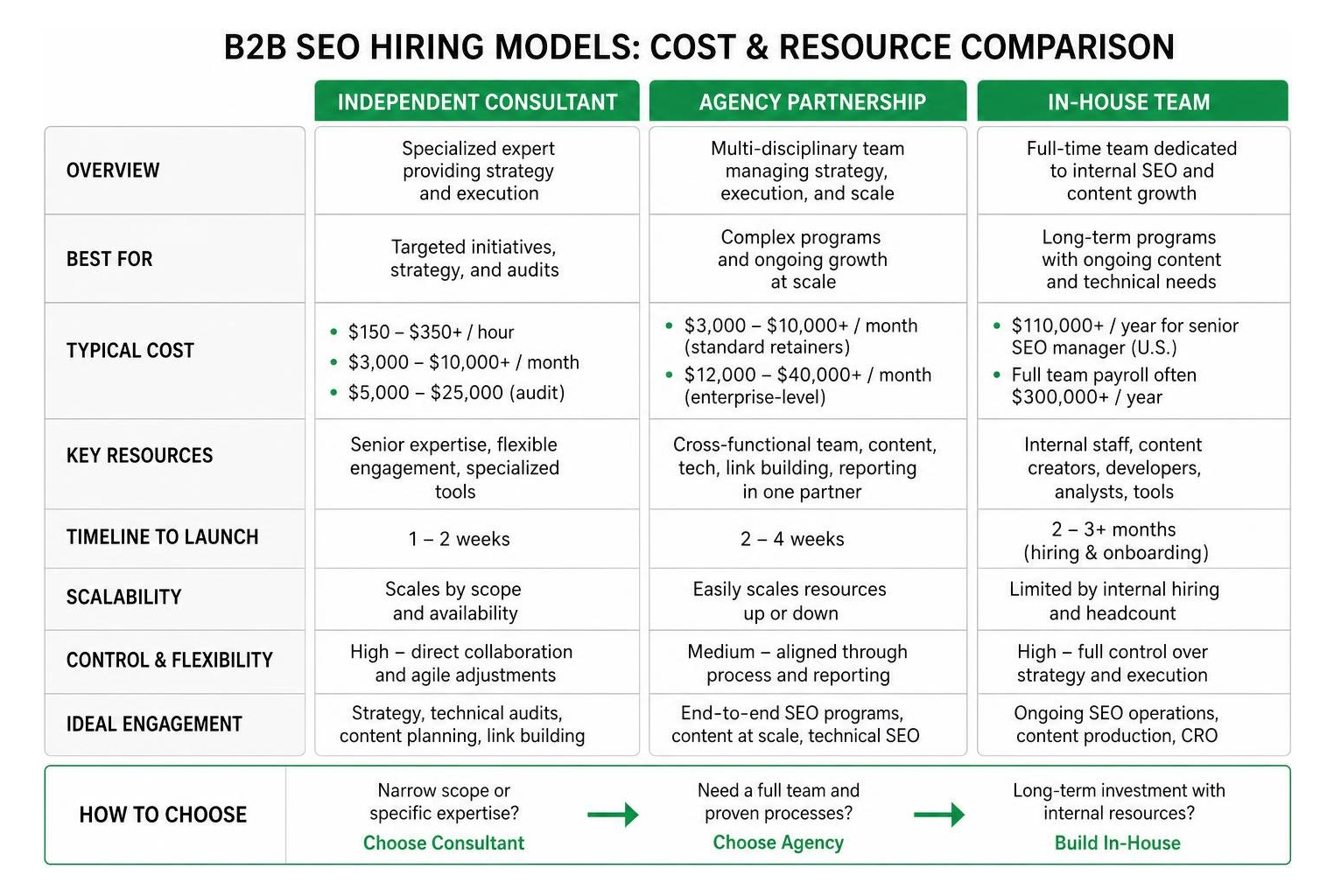
Pricing structures for external B2B search consulting vary depending on scope, domain complexity, and target outcomes:
- Monthly Retainers: Standard specialized B2B SEO retainers range between $3,000 and $10,000+ per month depending on the level of execution required. Top-tier enterprise-level consulting models can range from $12,000 to $40,000+ per month.
- Project-Based Strategy Audits: In-depth technical, content, and pipeline attribution audits typically cost between $5,000 and $25,000 as a one-off engagement.
- Hourly Rates: Senior B2B growth specialists generally command hourly rates between $150 and $350+ per hour.
For detailed options tailored to your specific market footprint, you can view available marketing and optimization services to see how strategic engagements are structured.
When to Hire an Independent B2B SEO Consultant vs. Building In-House
Choosing the right organizational model depends on your company’s organic maturity, speed-to-value requirements, and current internal resources.
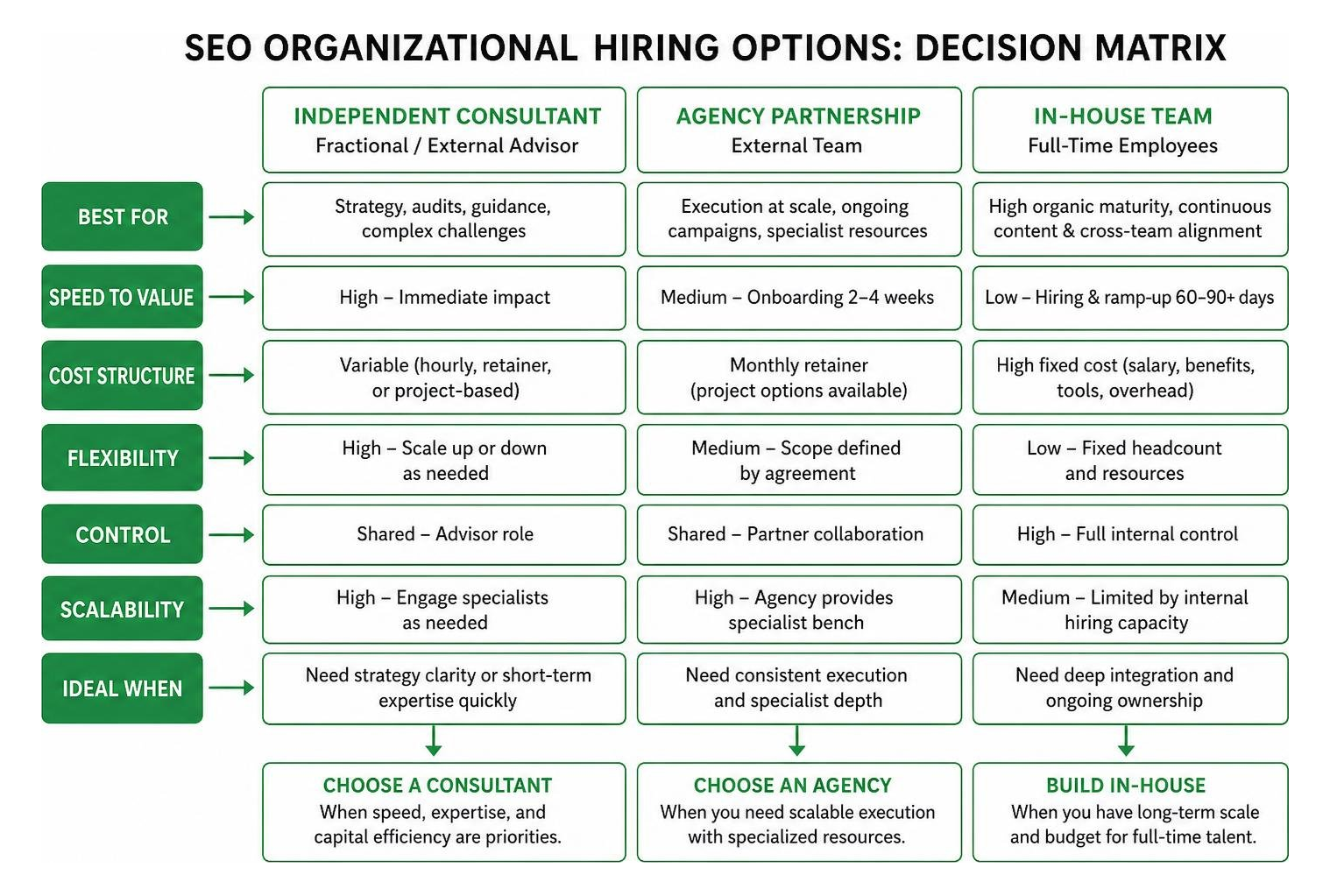
Hiring an independent consultant or fractional growth advisor is ideal when speed and high-level strategy are top priorities. Consultants eliminate the standard 60-to-90-day hiring and onboarding ramp-up risk associated with full-time hires. They deliver immediate capital efficiency, bringing proven frameworks directly to your leadership team.
Conversely, building an in-house team makes sense when a business reaches high organic maturity, produces massive content volumes daily, and requires full-time, on-site cross-department coordination. Many scaling companies use a hybrid model: hiring an external b2b seo consultant to architect high-level strategy while utilizing internal resources or specialized partners for day-to-day execution.
Evaluating Costs, Retainers, and Project-Based Engagements
When evaluating proposal costs, focus on ROI potential rather than bottom-line price alone. Selecting a partner based solely on a slightly lower fee can be counterproductive if they lack deep B2B context.
Prior to signing an agreement, insist on full clarity regarding who will execute the actual work. Ensure that senior strategy is not handed off to junior staff once the contract is secured. Establish clear scope boundaries around technical site updates, content output velocity, CRM tracking configurations, and quarterly pipeline evaluation metrics.
The Anatomy of a High-Impact Engagement Blueprint
A successful B2B search engagement follows a clear, structured framework tailored to long sales cycles and committee decision-making.

A comprehensive B2B SEO engagement roadmap generally unfolds across four key phases:
- Phase 1: Foundation & Revenue Audit (Months 1–2): Technical debt resolution, JavaScript rendering fixes, GA4 to CRM integration, base schema implementation, and buying committee query mapping.
- Phase 2: Intent-Driven Content Engine (Months 3–5): Publishing high-intent bottom-of-funnel content, “pain-point” articles, product comparison pages, and customer decision frameworks.
- Phase 3: Authority & AI Engine Distribution (Months 6–8): Generative Engine Optimization (GEO) execution, entity authority building, digital PR, and technical doc optimization.
- Phase 4: Pipeline Compounding & Scaling (Months 9–12+): Expanding into programmatic coverage, localized persona zoning, and optimization based on closed-won revenue data.
Initial technical adjustments usually show positive movement within 30 to 60 days. Content-driven pipeline momentum compounds over 4 to 9 months, while ranking for highly competitive enterprise keywords typically requires a 6 to 12 month sustained investment.
Mapping the Buying Committee Across Long Sales Cycles
B2B purchasing decisions are made by groups, which means your content must address the specific concerns of every committee member:
By mapping intent to specific personas, a b2b seo consultant ensures that when the buying committee meets, every decision-maker finds compelling content that answers their questions and addresses their concerns. Experienced growth consultants specialize in aligning overall brand authority and positioning across these complex multi-stakeholder journeys.
Measuring Success Through Pipeline Influence Instead of Vanity Metrics
To judge the true return on investment of a B2B search campaign, executive leadership must retire outdated vanity metrics. High organic traffic charts are meaningless if none of those visitors ever convert into sales pipeline.
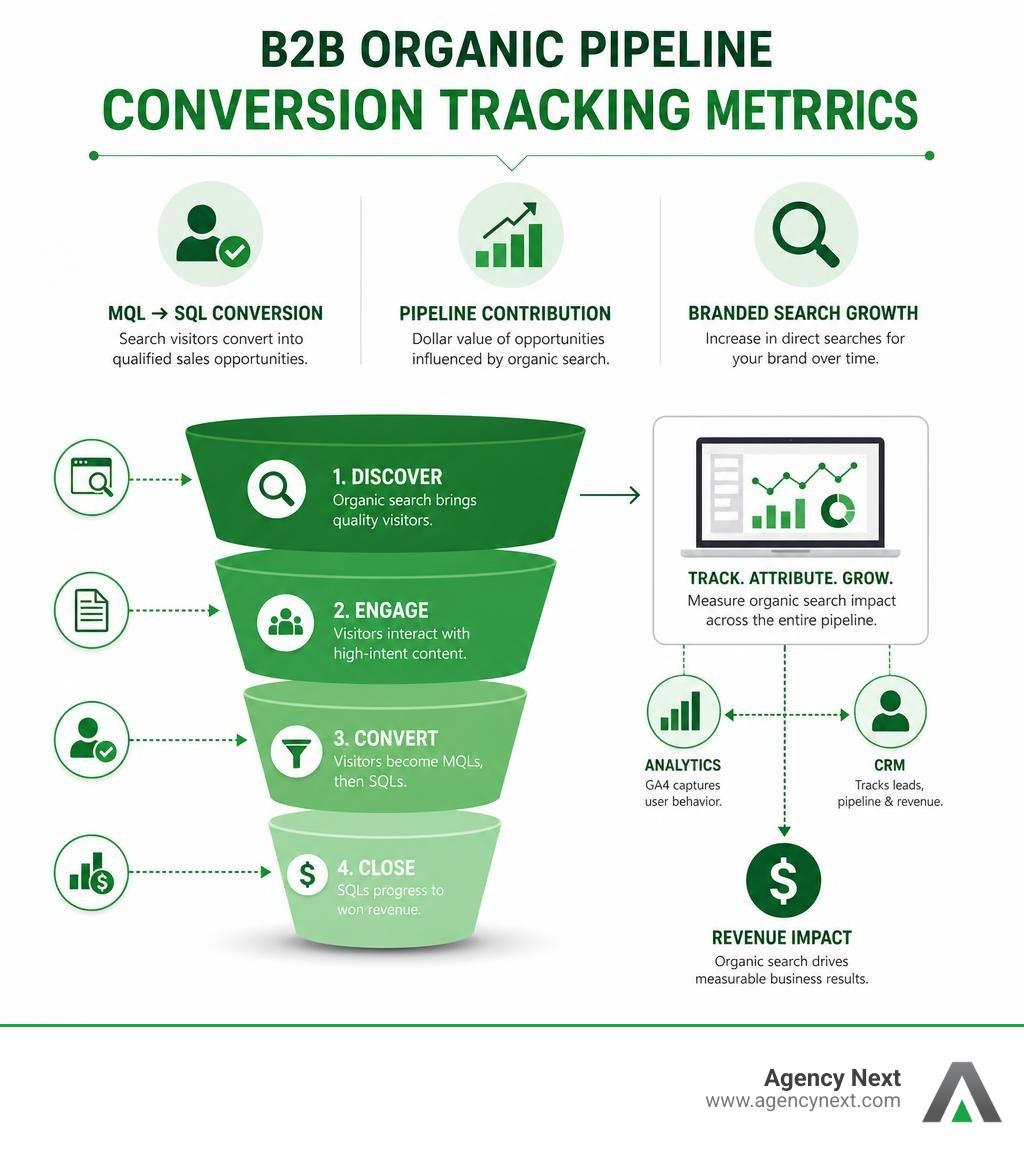
Instead of relying solely on broad keyword rankings, evaluate your SEO strategy against core business metrics:
- Marketing Qualified Leads (MQLs) to Sales Qualified Leads (SQLs): The conversion rate of search visitors turning into vetted sales opportunities.
- Pipeline Contribution: Total dollar value of active opportunities in your CRM that originated from or were influenced by organic search touchpoints.
- Branded Search Growth: Increases in direct searches for your company name—a clear indicator of expanding market presence.
- Customer Acquisition Cost (CAC) Reduction: Lower overall customer acquisition costs as organic touchpoints offset expensive paid media spend.
Experienced growth strategists structure growth engines specifically around RevOps metrics, ARR, and capital efficiency rather than standard rank tracking alone.
Common Pitfalls to Avoid When Selecting Your B2B SEO Partner
Selecting the wrong search partner can waste valuable time and budget while creating technical issues that disrupt your sales funnel.

Avoid these common mistakes when hiring a b2b seo consultant or agency partner:
- Chasing Raw Traffic Volume: Falling into the trap of prioritizing high-volume, generic keywords over low-volume, high-intent phrases that actually generate sales leads.
- Falling for Junior Team Reassignments: Contracting with an agency based on senior leadership sales pitches, only to have your account handed off to inexperienced staff following basic checklists.
- Accepting Cookie-Cutter Templates: Implementing generic B2C content playbooks that fail to account for long sales cycles and complex buying committees.
- Neglecting Modern AI Search (GEO): Working with partners who focus exclusively on traditional Google rankings while ignoring AI answer engines like ChatGPT, Claude, and Perplexity.
- Ignoring CRM Integration: Failing to connect organic search analytics directly into your CRM, leaving you unable to track organic influence on actual closed-won revenue.
Frequently Asked Questions about B2B SEO Strategy
How long does it take for a B2B SEO consultant to generate actual pipeline?
While initial technical fixes can deliver quick wins within 30 to 60 days, content-driven pipeline gains compound over 4 to 9 months. Achieving top positioning for highly competitive enterprise terms typically requires a sustained 6 to 12 month investment.
What should a company prepare before onboarding a B2B SEO consultant?
Before starting an engagement, companies should prepare documented Ideal Customer Profiles (ICPs), grant administrative access to Google Analytics 4 and Google Search Console, and establish clear revenue goals (e.g., target percentage increases in qualified sales pipeline).
How do AI search engines affect traditional B2B rank tracking?
AI search platforms introduce “zero-click” research environments where buyers receive answers directly inside conversational interfaces. As a result, success is increasingly measured by LLM citation density, third-party entity coverage, and branded search volume rather than traditional blue-link SERP ranks alone.
Conclusion
Building a high-performing organic revenue channel requires far more than basic technical fixes and surface-level blog posts. In an era shaped by complex buying committees and rapid AI adoption, B2B companies need search engines and conversational LLMs to consistently highlight their solutions during critical procurement evaluations.
By shifting your focus from vanity traffic metrics to qualified sales pipeline, pain-point SEO, and Generative Engine Optimization (GEO), you turn organic search into a predictable, long-term driver of business growth.
At Agency Next, we build conversion-focused websites, execute intent-driven B2B SEO strategies, produce AI-powered video content, and manage paid acquisition systems that turn search visibility into measurable revenue. Transform your organic search pipeline with our expert team and discover how a revenue-focused search strategy can help your business capture market share and drive scalable growth.