
Boost ROAS Overnight: Strategic Facebook Ad Social Proof Tactics for Marketers

Facebook Ad Social Proof Tactics That Build Trust Fast
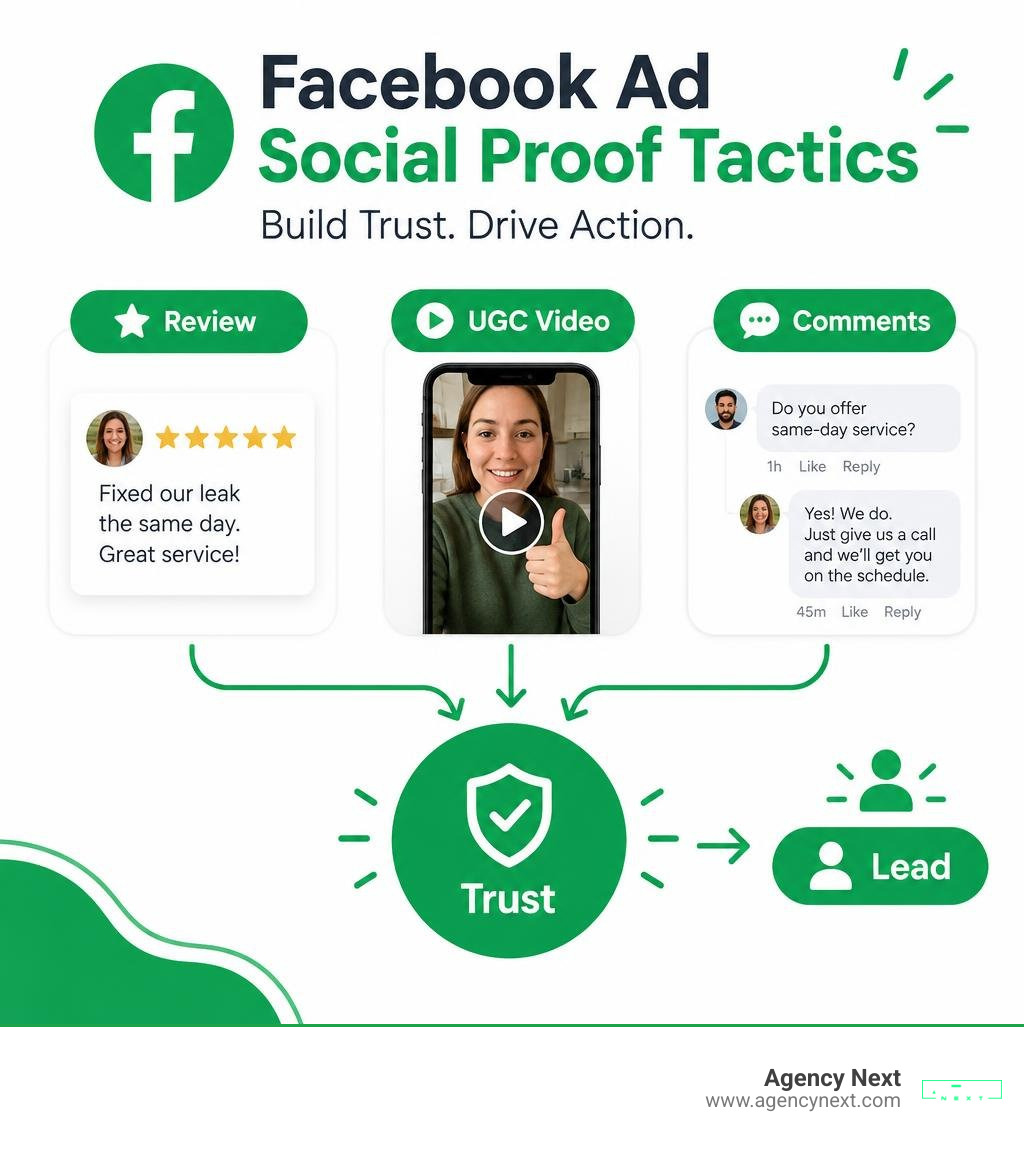
Use facebook ad social proof tactics to show real evidence that other people trust your business before asking a cold prospect to call, book, or buy. For a local service business, start with these three:
- Put a specific customer review and star rating directly on the ad.
- Run short, phone-shot customer or creator videos that show the problem, service, and result.
- Use comment or message-style creative to answer common concerns in plain language.
This works because people trust peers more quickly than polished sales claims. Reviews matter: 97% of consumers read them before choosing a business, and 93% say reviews have directly influenced a purchase. The goal is not to make an ad look popular. It is to make the next step feel lower-risk.
Strong proof is specific. “Fixed our leak the same day” is more believable and useful than “Great service.” Pair that proof with one clear offer and CTA, then test it against the same ad without the proof to see whether CTR, cost per lead, and ROAS improve.
I am Koby Luedtke, and the AGENCY NEXT Team will walk through the proof formats, sourcing rules, and tests that can help turn more Facebook ad clicks into qualified local leads.
The Behavioral Psychology Behind Social Proof in Meta Ads
Every time a user scrolls through their Meta feed, their brain processes hundreds of micro-decisions. When encountering an unfamiliar brand or offer, cognitive load spikes. Prospective buyers subconsciously ask: Is this legitimate? Will this waste my money? Has anyone like me actually tried this?
This hesitation stems from loss aversion. In behavioral economics, the pain of losing resources is roughly twice as powerful as the pleasure of gaining an equivalent benefit. To bypass this friction, human psychology relies on informational social influence—a concept formalized by psychologist Robert Cialdini. When people are uncertain, they look to the actions and consensus of others to guide their own behavior.
In digital advertising, social proof serves as a mental shortcut (a heuristic). Instead of evaluating technical product specifications or sales promises, prospects rely on peer validation to gauge safety and quality.
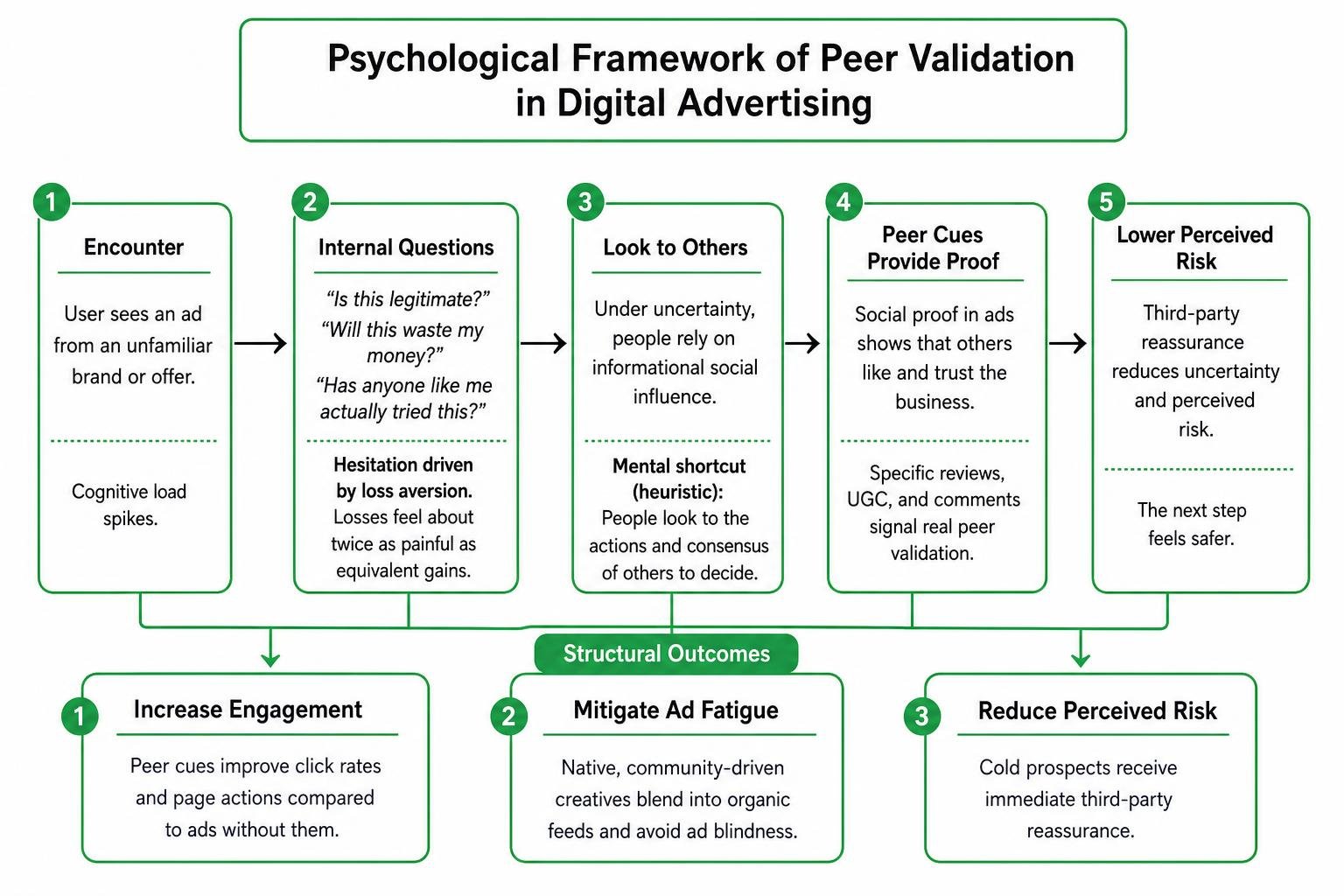
The structural impact of these social cues is documented in quantitative research. In scientific research on peer influence in social advertising, researchers examined over 100 million user-ad interactions on Facebook. The study proved that displaying minimal peer cues (such as showing that a friend engaged with a brand) significantly increased click rates and page actions compared to identical ads lacking those cues. Showing a second peer cue increased click rates by 10.3%, with strong-tie connections driving greater conversion lift than weak ties.
By introducing authentic peer cues into paid media campaigns, you achieve three structural outcomes:
- Mitigate Ad Fatigue: Native, community-driven creatives blend into organic social feeds, avoiding the visual blindness caused by glossy promotional banners.
- Reduce Perceived Risk for Cold Audiences: Cold prospects who have never heard of your brand receive immediate third-party reassurance.
- Accelerate Decision Velocity: Answering common buyer objections inside the creative reduces time spent deliberating on the landing page.
8 High-Converting Facebook Ad Social Proof Tactics to Test
Deploying social proof effectively requires choosing the format that best addresses your target audience’s primary objections.

The following comparison outlines the primary social proof creative formats, their relative production complexity, and their primary conversion mechanism:
| Social Proof Format | Primary Conversion Mechanism | Creative Effort | Best Funnel Stage |
|---|---|---|---|
| 1. Review & Star Overlays | Direct trust signal & immediate credibility | Low | Top / Middle of Funnel |
| 2. Raw UGC Videos | Problem-solution empathy & product demo | Medium | Top / Middle of Funnel |
| 3. Comment Screenshot Hooks | Objection handling & authenticity | Low | Top / Bottom of Funnel |
| 4. DM Flood / Text Exchange | Implied viral demand & curiosity | Low | Top of Funnel |
| 5. Testimonial Carousels | Persona-based objection stacking | Medium | Middle / Bottom of Funnel |
| 6. Authority & Trust Badges | Risk reversal & third-party validation | Low | Bottom of Funnel |
| 7. Aggregate Milestones | Herd validation & brand scale | Low | Top / Middle of Funnel |
| 8. Podcast / Interview Clips | Authority transfer & organic immersion | High | Top / Middle of Funnel |
1. Direct Customer Review & Five-Star Rating Overlays
Static images or short video clips overlaid with star ratings and concise customer quotes represent one of the most reliable formats in paid social. Meta’s interface rewards clean visual hierarchies where the value proposition is readable within three seconds.
To maximize performance:
- Target the Authenticity Sweet Spot: Counterintuitively, a flawless 5.0 rating can trigger skepticism. Consumer research shows that ratings between 4.2 and 4.5 stars often convert at higher rates because shoppers perceive them as genuine and uncensored.
- Pair Ratings with Specific Volume: Display both the rating and the sample size (e.g., “4.9 Stars across 1,420+ Verified Clients”). In large-scale empirical studies analyzing e-commerce reviews, review volume correlates positively with purchase decisions ($\alpha_2 = 0.662, p < 0.001$).
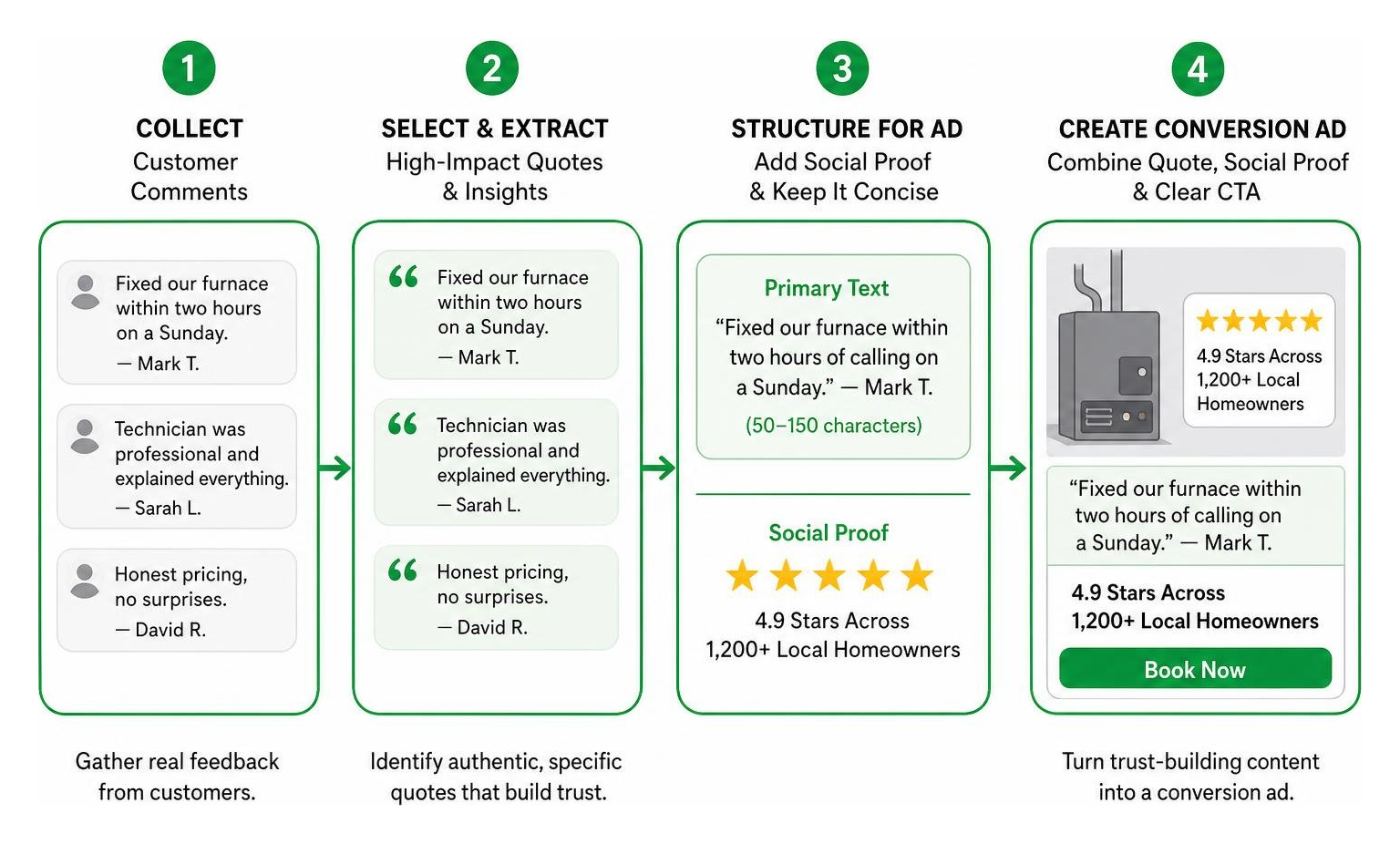
- Keep Primary Text Concise: Adhere to Meta’s recommended primary text range of 50 to 150 characters on feed placements to avoid truncation before the core quote is read.
2. Raw User-Generated Content (UGC) Video Testimonials
High-production studio advertisements often trigger immediate banner blindness in social feeds. By contrast, raw user-generated content shot on a smartphone disarms skepticism because it mimics a recommendation from a friend.
According to data on UGC testimonial ad performance in 2026, UGC-based ads achieve up to 4x higher click-through rates and a 50% reduction in cost-per-click compared to standard brand display creative. Furthermore, 64% of viewers report being more likely to purchase after watching a video testimonial.
To build an effective UGC video ad:
- The Visual Hook (0–3s): Open directly with the creator holding the product or speaking candidly to the camera about an acute frustration (e.g., “I spent three months trying to fix our billing workflow until…”).
- The Agitation & Experience (3–10s): The creator shows the problem, unboxes the product, or demonstrates the service in an everyday setting with natural lighting.
- The Concrete Result (10–20s): Highlight a measurable outcome rather than generic satisfaction (e.g., saving four hours weekly or eliminating joint pain during morning workouts).
- The Clear Call-to-Action (20–30s): A straightforward prompt directing users to the offer.
3. Comment Screenshot Overlays & Negative Comment Rebuttals
Native interface elements—such as TikTok comment bubbles, Instagram question stickers, or Meta comment screenshots—create an immediate visual pattern interrupt.
Marketers can leverage two variations of this tactic:
- The Validation Overlay: Place a real customer comment sticker at the top of the video frame (e.g., “Does this actually work for sensitive skin?”) while the creator answers the question through a direct demonstration.
- The Negative Comment Rebuttal: Select a skeptical or critical comment (e.g., “Looks flimsy, probably breaks in a week”) and record a creator putting the product through stress testing to visibly prove durability. Addressing objections directly builds brand transparency and neutralizes common conversion blockers.
4. Direct Message (DM) Flood & Text-Exchange Hooks
Mimicking familiar communication channels creates immediate curiosity. When users see a creative designed like an Apple iMessage or WhatsApp exchange, their instinct is to read the conversation.
- The Text Exchange Creative: Design a split-screen or animated static image showing a conversation between two friends (e.g., “What was that service you used for your kitchen remodel?” followed by an enthusiastic response and photo of the finished project).
- The “DM Flood” Narrative Hook: Open a video ad with a screen recording of an inbox overflowing with unread messages, paired with voiceover copy: “My DMs have been blowing up asking where I got this…” This narrative device establishes implied viral demand before introducing the product pitch.
5. Multi-Card Testimonial Review Carousels
Carousel ads allow you to segment testimonials by customer persona, target demographic, or specific use case across multiple sequential cards.
- Card 1 (Persona A – Cost Concerns): Features a customer highlighting affordability and direct ROI metrics.
- Card 2 (Persona B – Ease of Use): Showcases a quote emphasizing fast onboarding and zero learning curve.
- Card 3 (Persona C – Customer Support): Focuses on rapid turnaround times and service reliability.
- Final Card (Aggregate Summary & CTA): Summarizes overall customer metrics (e.g., “Join 15,000+ happy clients”) with a direct conversion button.
Swiping through a carousel increases user engagement signals within Meta’s delivery algorithm, driving down overall cost-per-impression (CPM).
6. Authority Badges, Industry Certifications, and Press Mentions
While peer reviews drive emotional trust, institutional validation provides logical risk reversal—particularly for high-ticket services, medical practices, or B2B contracts.
- Editorial Badges: Highlight features in recognized industry publications or news outlets across the lower third of static and video assets.
- Regulatory & Quality Certifications: For technical, security, or wellness products, display accredited compliance badges (e.g., ISO, GMP, BBB Accredited, licensed master technicians).
- Execution Rule: Badges must resolve a specific transaction risk. A generic security icon adds visual clutter; an explicit “Licensed, Bonded & Insured across Wisconsin” banner answers a practical objection for a local homeowner.
7. Aggregate Customer Milestones & Volume Metrics
Large numbers communicate safety in numbers. When shoppers see that tens of thousands of people have already purchased, the perceived risk of making a mistake drops significantly.
- Customer Milestones: Incorporate data points directly into visual badges (e.g., “Over 25,000 Homes Serviced” or “Trusted by 4,500+ Active Athletes”).
- Real-Time Volume Signals: Use dynamic copy or visual banners indicating monthly client sign-ups or product shipments.
- Category Dominance Proof: Cite market share statistics or verified operational metrics to reinforce that your brand is an established industry choice.
8. Podcast Clips & Creator Interview Cuts
Studio-style podcast interviews command high authority. Placing two individuals with broadcast microphones in a conversational studio setup signals to the viewer that the dialogue contains valuable editorial insight rather than a direct sales pitch.
- Audio-First Hook: Open the video clip mid-sentence during a compelling insight or storytelling moment (e.g., “The biggest mistake most business owners make when scaling their ads is…”).
- Organic Look and Feel: Use casual framing, natural speech cadences, and dynamic subtitles across the center of the video to maintain viewer attention even with the sound muted.
- Authority by Association: Co-hosting conversations with recognized niche experts or creators allows your brand to inherit third-party credibility.
Aligning Social Proof Formats Across the Marketing Funnel
Not all social proof formats perform equally across every stage of the buyer journey. Cold prospects require broad validation to build basic brand familiarity, whereas warm prospects near the point of purchase require hyper-specific objection handling.

Marketers looking to scale campaigns can consult our curated growth marketing resources for additional campaign structuring frameworks.
- Top-of-Funnel (TOFU): Cold audiences do not know your brand. Deploy UGC problem-solution reels, podcast interview snippets, and aggregate customer milestone numbers. The goal is broad relatability and proof of category adoption.
- Middle-of-Funnel (MOFU): Users who have visited your website or engaged with social accounts understand their problem and are evaluating solutions. Deploy multi-card carousels addressing specific personas and side-by-side competitor comparisons.
- Bottom-of-Funnel (BOFU): Retargeting audiences who abandoned a checkout or lead form need risk elimination. Deploy short static quotes highlighting fast fulfillment, stellar customer support, industry certifications, and money-back guarantees.
Sourcing, Compliance, and Testing Your Proof Strategy
A disciplined process for sourcing, legally clearing, and testing customer assets is required to run proof-driven ad campaigns effectively over time.
Sourcing Authentic Assets for Facebook Ad Social Proof Tactics
To generate a predictable stream of raw social proof assets:
- Automate Post-Purchase Review Collection: Implement automated email and SMS review request flows triggered 7 to 14 days post-delivery. Incentivize customers to submit short vertical videos detailing their experience.
- Conduct Systematic Review Mining: Regularly audit your customer service logs, Google Business profile, and social comments. Extract high-impact phrases that mention specific numbers, timeframes, or relief from past frustrations.
- Use Structured Creator Briefs: When collaborating with content creators, supply a brief outlining the required structural beats (hook, problem agitation, demonstration, result) while allowing them to use their own natural conversational language.
- Secure Legal Rights and Licensing: Always obtain explicit, signed media release agreements before using customer names, likenesses, or quotes in paid advertising. Ensure compliance with FTC endorsement guidelines by clearly disclosing material connections and avoiding non-standard performance claims without typical results disclosures.
How to A/B Test Your Facebook Ad Social Proof Tactics
To determine whether your proof elements are driving measurable performance lifts, run disciplined split tests:
- Isolate a Single Creative Variable: Test a control creative (e.g., a standard product benefit ad) against an identical variant containing a five-star overlay or customer testimonial quote. Keep copy, headline, landing page, and audience targeting uniform.
- Use Meta’s Native A/B Testing Tool: Run tests through Meta’s native experiment tool to ensure random, non-overlapping audience splits and prevent cross-exposure contamination.
- Establish Sample Size Thresholds: Aim for a minimum of 10,000 impressions and at least 50 to 100 conversion events per variant before declaring a winner, evaluating metrics at a 95% statistical confidence level.
- Run Campaigns for 7 to 14 Days: Allow tests to run through full weekly business cycles to account for day-of-week conversion fluctuations.
- Analyze Winning Metrics: Review our documented client case studies and performance work to see how systematic split testing consistently lowers customer acquisition costs across competitive verticals.
Frequently Asked Questions About Facebook Ad Social Proof
How many reviews or customer ratings are needed before running proof-based ads?
While industry benchmarks show that online shoppers often look for approximately 112 reviews across a storefront to feel complete confidence, you do not need hundreds of reviews to begin advertising. You can launch effective campaigns with a single detailed, metric-focused customer story. If your total review volume is low, prioritize in-depth UGC video case studies or expert endorsements over aggregate star-rating badges.
Can negative comments or mixed star ratings improve ad conversions?
Yes. Consumers are increasingly skeptical of unblemished 5.0-star ratings. Research shows that ratings between 4.2 and 4.5 stars often convert exceptionally well because they appear honest. Additionally, using video ads that directly address a skeptical or critical user comment can disarm objections and build transparent credibility.
How often should social proof creatives be refreshed to prevent ad fatigue?
Creative refresh cycles depend on ad spend and audience size. For accounts with moderate media spend, refresh your core social proof assets every 4 to 8 weeks. Performance data indicates that creative testing volume directly drives account scaling: accounts launching 20 to 50 fresh creative variations per cycle identify twice as many winning ad units compared to low-volume advertisers.
Conclusion
Sustained performance in paid social advertising relies on addressing customer hesitation before asking for a conversion. Incorporating authentic customer quotes, raw UGC video demonstrations, comment overlays, and verified third-party trust signals transforms standard ads into high-converting assets that lower customer acquisition costs.
At Agency Next, we build custom conversion systems for local businesses and organizations—combining data-driven creative production with strategic media execution. If you are ready to scale your campaigns and improve your return on ad spend, explore our comprehensive paid social and ad management services to get started.