
International SEO Consultant Tactics for Cross-Border Growth

Expand Search Visibility Across Borders With International SEO
An international SEO consultant helps a business become visible in the countries and languages where it wants to grow. Unlike a standard SEO specialist, this role looks beyond rankings in one market to plan the site structure, language targeting, local search intent, and technical signals that help search engines show the right page to the right audience.
For a business entering new markets, the quick answer is simple:
- Hire an international SEO consultant before launching new country pages, language versions, or domains.
- Use their guidance to avoid costly decisions around URL structure, translations, redirects, and hreflang tags.
- Build visibility with content and authority that match how people search in each region – not just direct translations of home-market pages.
- Track traffic, rankings, leads, and conversions by country and language.
Cross-border growth can create new leads, but it also adds complexity. A site that works well in the U.S. may need different keywords, currencies, trust signals, content, and technical setup to compete in Canada, the U.S., Europe, or other markets. The wrong setup can split authority, create duplicate pages, or send visitors to the wrong version of a site.
I’m Koby Luedtke, Co-Founder of Agency Next, where I help businesses improve visibility, trust, and conversions through websites, SEO, video, and digital strategy. While an international SEO consultant focuses on cross-border search growth, my work in marketing strategy and conversion-focused digital experiences brings a practical business lens to the decisions covered in this guide.
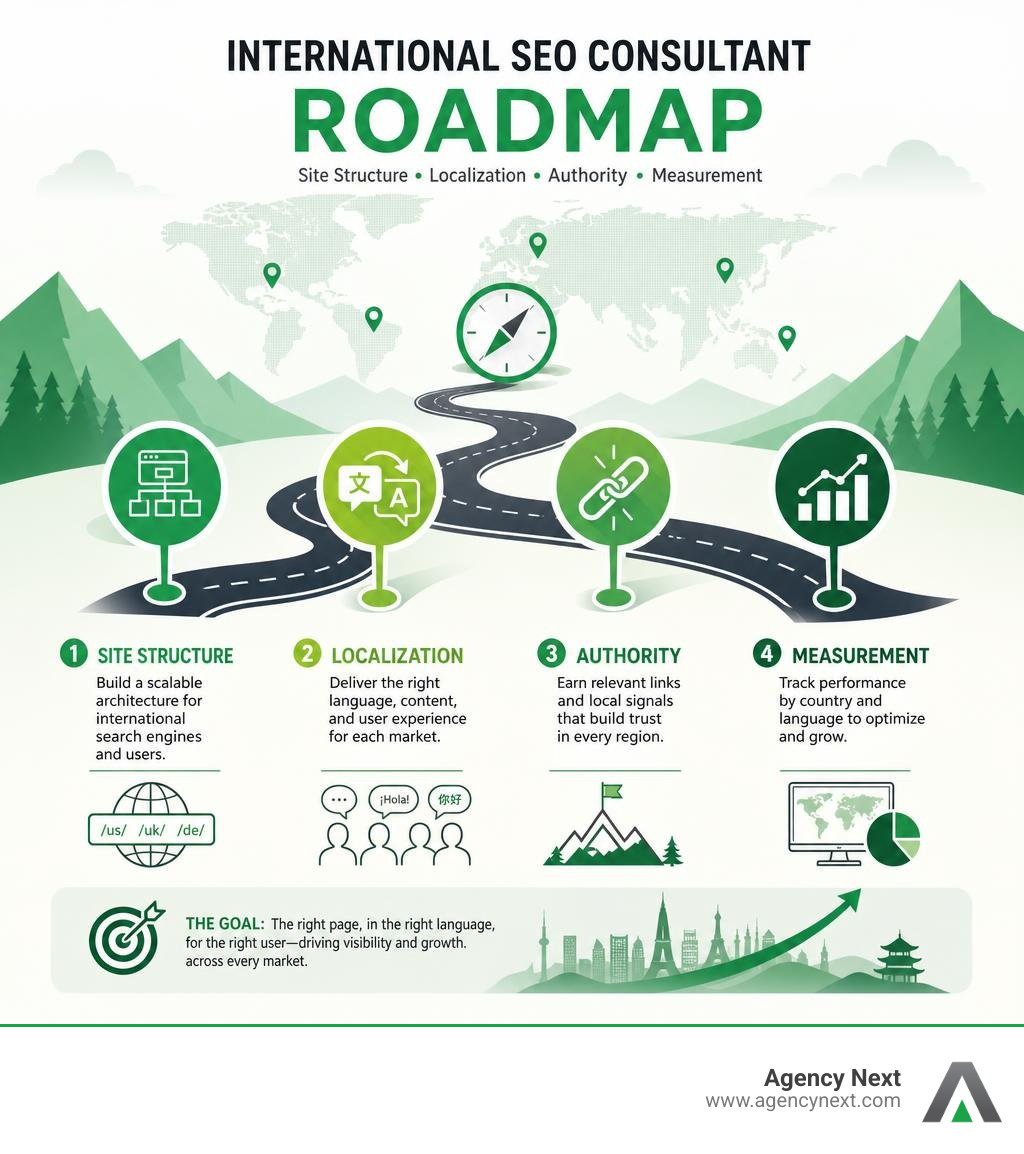
What an International SEO Consultant Does vs Standard SEO
When scaling a business across national borders, many organizations assume that what worked in their domestic market will easily replicate overseas. However, cross-border search optimization requires an entirely different playbook. While a domestic SEO campaign focuses on ranking individual pages for a unified target market, international SEO deals with structural scaling, regional search behaviors, and complex technical indexing rules.
At Agency Next, we see international search as a strategic expansion exercise rather than a simple translation task. An experienced international SEO consultant establishes a multi-regional architecture, builds a sustainable localization framework, and ensures that search engines like Google, Baidu, Yandex, or Naver route users to the appropriate regional experience. You can explore our marketing and growth guides in our digital resources to learn more about overarching digital strategies.
Core Differences Between Local Specialists and an International SEO Consultant
A local SEO specialist crafts strategies around local keywords, domestic backlinks, and localized user intent within one primary country or language. In contrast, an international SEO consultant coordinates a web of technical protocols and cultural adaptations across dozens of target markets.
Key differences include:
- Geo-Targeting & URL Governance: Local specialists manage a single domain. International experts evaluate whether to deploy country-code top-level domains (ccTLDs), subdirectories, or subdomains to signal geographic targeting effectively.
- Language Mapping & Hreflang Architecture: An international consultant maps cross-language relationships using reciprocal hreflang annotations, preventing search engines from viewing translated pages as duplicate content.
- Global Crawl Budget Management: Managing hundreds or thousands of localized pages across regional servers requires optimizing crawl efficiency so search engine bots index key commercial pages without getting stuck in infinite redirects.
- Technical & Localization Specifications: International consultants create technical guidelines for developers and local copywriters, ensuring that content reflects real search volume, regional phrasing, local currency formats, and cultural search nuances.
When to Hire an International SEO Consultant for Global Expansion
Timing is everything in cross-border growth. Bringing in an international SEO consultant before making domain purchases or coding headless CMS setups prevents high-stakes, hard-to-fix structural blunders.
We recommend engaging global search expertise during the following phases:
- Pre-Launch Strategy: Before launching new language versions or acquiring overseas domain names, a consultant conducts international keyword research and architectural planning.
- Domain Selection & Site Design: Choosing between a unified global domain or localized ccTLDs dictates your long-term link equity and operational overhead.
- Structural Migration: If your business is consolidating separate regional sites into a central subfolder architecture (or expanding from a single site to multi-regional nodes), consulting expertise ensures seamless authority migration.
- Global Ranking Recovery: When existing international subfolders or subdomains experience sudden traffic drops, a consultant diagnoses geo-redirection errors, broken hreflang loops, or regional algorithmic penalties.
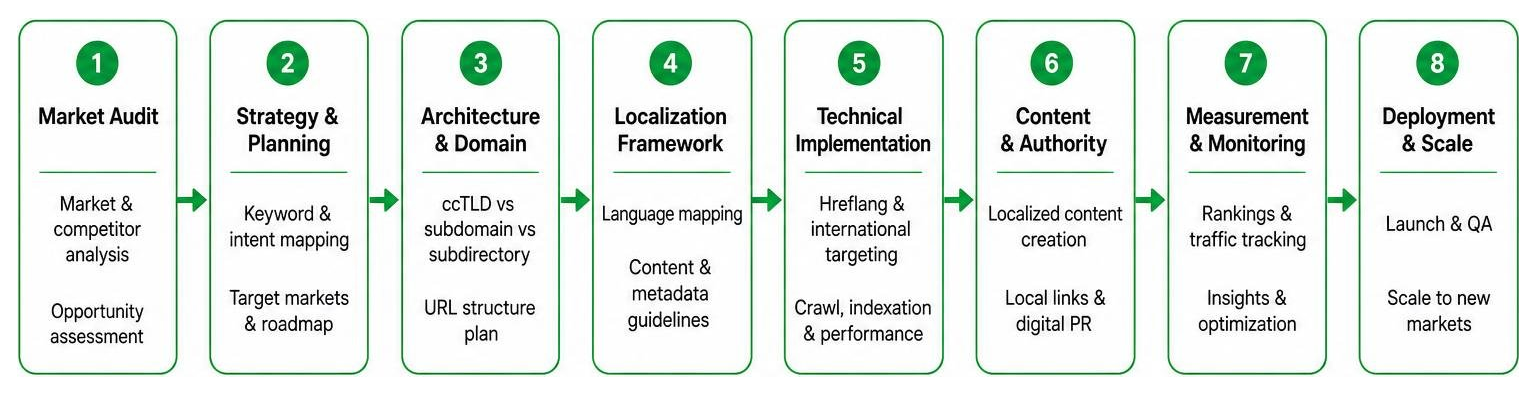
Technical Architecture and Common Mistakes in Cross-Border Expansion
Expanding a web property internationally without technical oversight often leads to irreversible structural mistakes. Mistakes made at the infrastructure level—such as incorrect domain choices or forced IP redirects—can destroy years of accumulated domain authority and alienate international consumers.
Site Architecture: Evaluating ccTLDs, Subdirectories, and Subdomains
One of the first structural decisions facing an expanding brand is how to house regional content. Selecting the right URL framework depends on your budget, technical resources, and immediate brand recognition in target markets.
| Architecture Option | Example URL | Primary Advantages | Main Disadvantages | Best Used When |
|---|---|---|---|---|
| ccTLDs | agencynext.fr |
Strongest local geo-targeting signal; higher initial trust from local users. | Zero shared domain authority; high cost and overhead to maintain separate domains. | You have massive local marketing budgets and established regional operations. |
| Subdirectories | agencynext.com/fr/ |
Consolidates all authority into root domain; lower cost; easy setup. | Weaker automatic geographic trust signal; requires precise hreflang configuration. | You want to leverage existing domain authority for fast market entries. |
| Subdomains | fr.agencynext.com |
Flexible hosting setup; allows separate server locations per region. | Domain authority does not fully pass from root domain; treated almost as separate sites. | Different regional sites run on completely separate CMS platforms or tech stacks. |
Subdirectories are generally the most cost-effective and authority-friendly route for companies scaling globally. By keeping all localized content on a single root domain, new language sections benefit from the trust and link equity accumulated by the main brand.
Hreflang Tags in 2026: Pitfalls and Execution
Hreflang tags tell search engines which language and country version of a webpage to display to a user based on their location and language settings. Although the concept is simple, technical execution remains a frequent point of failure.
Common hreflang pitfalls include:
- Missing Reciprocal Links: If Page A (US) points to Page B (FR), Page B must point back to Page A. Without reciprocal tagging, search engines ignore the annotations.
- Incorrect Language and Region Codes: Using invalid ISO codes (such as using
ukinstead ofgbfor the United Kingdom) breaks regional targeting. - Headless CMS and Dynamic Rendering Conflicts: In modern headless architectures, client-side JavaScript often fails to render hreflang tags in the initial HTML payload, causing search engines to miss them entirely.
- Canonicalization Strategy Mismatches: Pointing hreflang attributes to pages that have canonical tags pointing elsewhere creates conflicting signals that confuse search engine crawlers.
When implemented correctly, hreflang prevents duplicate content issues between localized variants (such as U.S. English vs. U.K. English) and ensures search engines serve the exact localized experience designed for each audience.
Bridging Traditional SEO and Generative Engine Optimization (GEO)
As search technology evolves, cross-border growth in 2026 requires more than ranking on traditional search engine results pages (SERPs). The rise of Generative Engine Optimization (GEO) means brands must also optimize for AI-driven engines like ChatGPT, Perplexity, Gemini, and Google AI Overviews.
An expert international SEO consultant understands that traditional SEO focuses on getting specific web pages found and indexed, whereas GEO focuses on building a unified brand entity that AI models trust, reference, and cite in user answers.

Why Google Rankings Do Not Guarantee AI Citations
Holding a top-three organic ranking on Google in a specific country does not automatically mean an AI search engine will cite your brand in generated answers. Traditional search engines evaluate page-level signals like keyword placement, user engagement, and contextual backlinks.
AI answer engines, on the other hand, evaluate cross-platform entity confidence. They look for independent third-party corroboration across news media, trade directories, Wikipedia entries, and customer review platforms. If your brand positioning is inconsistent or lacks verified local third-party proof in a given country, AI models will skip citing your site in favor of competitors with clearer entity profiles—even if your web page technically ranks higher on standard SERPs.
AI Search Crawling, llms.txt, and Brand Consistency
To ensure AI engines discover and correctly contextualize your brand across international markets, businesses must maintain explicit technical access and uniform brand narratives.
- Verify Crawler Permissions: Check your
robots.txtfile to ensure you aren’t inadvertently blocking AI crawlers like GPTBot, PerplexityBot, ClaudeBot, or Google-Extended from accessing public-facing content. - Deploy
llms.txtStandard: Utilize anllms.txtfile at the root directory to provide a clean, markdown-based roadmap of your core brand information, product catalogs, and key market documentation specifically formatted for Large Language Models (LLMs). - Align Brand Positioning Across Languages: Because non-English AI models are often trained on smaller datasets, uncorroborated or conflicting brand descriptions across translated pages can confuse LLMs. Ensure consistent messaging on third-party sites, press releases, and regional profiles across every target language.
Building Local Authority and Measuring Global KPIs
Acquiring visibility in a new market requires building genuine regional authority. A common misstep is relying solely on home-market prestige without establishing local context. To succeed globally, businesses must foster regional links, localized E-E-A-T (Experience, Expertise, Authoritativeness, and Trustworthiness), and market-specific trust signals.
Combining strong technical architecture with localized semantic link building can produce impressive results—such as achieving a 40% organic traffic increase in just 6 months for expanding enterprises.
Transferring Domain Authority vs Establishing Local Trust
While operating on a subdirectory architecture allows you to share overall domain authority from your root domain, it does not automatically give you local entity trust in a new country. Search engines look for local relevance markers before ranking a site for competitive terms in new regions.
To establish localized trust, businesses should:
- Secure Regional Backlinks: Acquire links from local trade publications, regional news outlets, industry blogs, and country-specific directories (e.g.,
.dedomains for Germany,.co.ukdomains for the U.K.). - Generate Regional Digital PR: Publish localized research studies, press releases, and expert commentary tailored to the specific economic or social climate of each target market.
- Implement Localized Structured Data: Use Schema.org markup to explicitly specify target regions, local currencies, regional address details, and localized organization details.
Metrics and Analytics for Multilingual Search Success
Measuring international search performance requires segmenting data by country, language, and search engine platform. Relying strictly on site-wide metrics obscures regional wins and hides technical failures in specific markets.
Key international SEO KPIs include:
- AI Visibility Rate: Track how frequently your brand is cited across major AI answer engines (ChatGPT, Perplexity, Copilot, Gemini) for key customer prompts in each target language.
- Country-Specific Organic Traffic: Monitor organic traffic growth broken down by geographic filters within Google Search Console and web analytics tools.
- Regional Keyword Rankings: Track top-3 and top-10 rankings for localized search terms rather than direct translations of domestic keywords.
- Market Conversion Rates: Measure regional form submissions, demo requests, or product sales to ensure landing pages resonate culturally with local audiences.
- Regional Backlink Acquisition Rate: Track the growth of high-authority external links originating from target country top-level domains.
Case studies across various industries demonstrate that targeted site revamps, analytics alignment, and structural overhauls can drive remarkable growth—including cases achieving a 69% increase in page views, a 37% rise in organic reach, or scaling organic traffic from 600+ to over 7,000 monthly unique visitors within 12 months.
Frequently Asked Questions About International SEO
What are the most common technical challenges for multilingual websites?
The most common technical challenges for multilingual websites include misconfigured hreflang tags, canonical tag mismatches, server latency issues for distant overseas visitors, missing localized schema markup, and dynamic IP redirection loops that block search engines from crawling regional subfolders.
How long does it take to see results from cross-border SEO strategies?
Most international SEO campaigns begin showing measurable improvements in regional search visibility within 3 to 6 months. Timeline factors include your existing root domain authority, the technical complexity of your site architecture, the level of search competition in target countries, and how quickly regional search engines crawl and index your updated localized content.
Can home-market domain authority automatically boost new market rankings?
Home-market domain authority provides a strong foundational boost if you use a subdirectory structure (agencynext.com/uk/), as link equity is shared across the domain. However, authority alone does not guarantee high rankings. Search engines still require localized trust signals, local backlink references, localized search intent alignment, and region-specific schema before awarding top rankings in new markets.
Conclusion
Expanding search visibility across international borders opens up unprecedented market opportunities, but success depends on strategic precision. From choosing between ccTLDs and subdirectories to resolving hreflang syntax loops and optimizing for Generative Engine Optimization (GEO), an international SEO consultant provides the roadmap needed to scale seamlessly without risking your core brand authority.
At Agency Next, we combine conversion-focused website architecture, digital strategy, SEO, and cutting-edge media solutions to help businesses turn global traffic into sustainable growth. Whether you are preparing to enter your first overseas market or fixing underperforming international subfolders, our team is built to help you navigate cross-border digital expansion. Explore our marketing services, learn more about our team, or contact us today to elevate your international digital strategy.